

Most people think habits are just routines.
In reality, habits do much more than organise your day. They shape how your brain works, how you respond to situations, and even how easy or difficult change feels over time. The small actions you repeat every day do not stay small for long. They gradually influence your thinking, behaviour, and results.
That is why habits can either improve your life quietly in the background or slowly make things harder without you noticing.
In this guide, you will learn how habits shape your brain, why repeated behaviour becomes automatic, and how to use that knowledge to create better long-term change.
What a Habit Actually Is
A habit is a behaviour your brain learns to repeat with less effort.
When you do something often enough, your brain starts treating it as familiar. Instead of making a fresh decision each time, it creates a shortcut. This saves mental energy and makes the action easier to repeat.
That is why habits can feel automatic.
Examples include:
- checking your phone first thing in the morning
- drinking tea at the same time every day
- going for a walk after dinner
- reaching for snacks when stressed
- opening your laptop and starting work at a certain hour
Some habits are helpful. Some are not. But both work through the same basic brain process.
How Habits Shape Your Brain
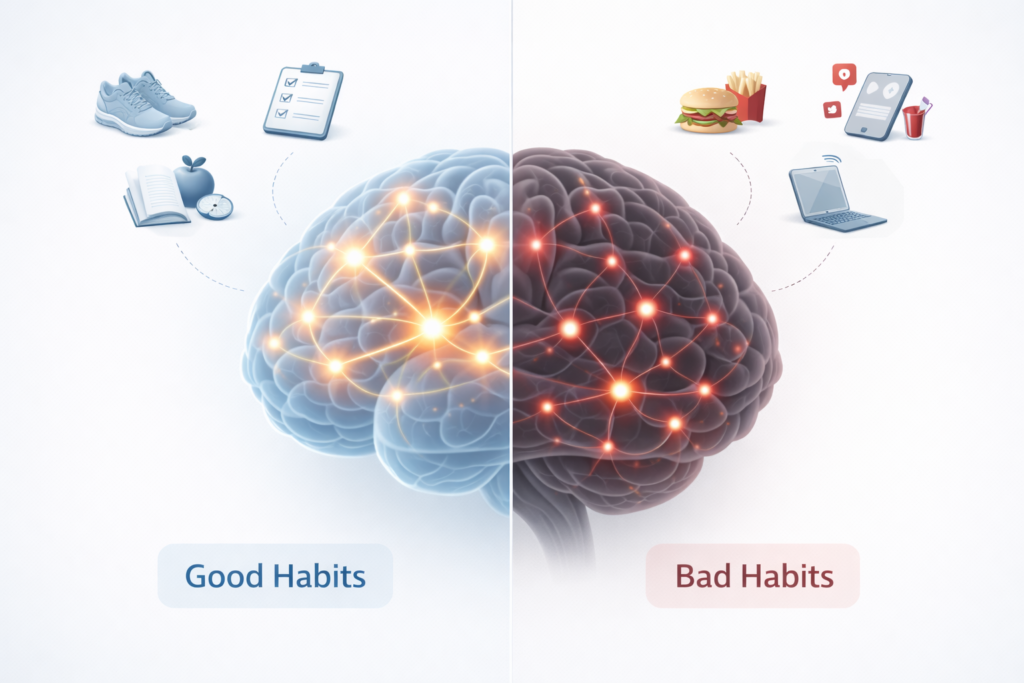
Your brain changes based on what you repeat.
This is one of the most important ideas in behaviour change. Repeated actions strengthen mental pathways. The more often you do something, the more familiar and efficient that pathway becomes.
In simple terms:
- repeated behaviour becomes easier
- easier behaviour becomes more likely
- more likely behaviour becomes a habit
That is why practice matters. It is not just about discipline. It is about training your brain through repetition.
Your brain likes efficiency
Your brain is always looking for ways to save effort.
If it can turn a repeated action into a routine, it will. This frees up mental energy for other tasks. It is useful when the habit is positive, such as exercising regularly or planning your day. It becomes harmful when the habit is negative, such as procrastinating, overeating, or scrolling mindlessly.
The brain does not judge whether the habit is good or bad. It mainly responds to repetition and reward.
Repetition strengthens behaviour
The first time you do something, it usually takes more effort.
The tenth time feels easier.
The fiftieth time may feel normal.
That is the power of habit formation. The brain starts recognising the pattern and reduces the friction involved in doing it again.
This is why changing behaviour often feels awkward at first. You are trying to build a new pathway while weakening an old one.
Why Bad Habits Feel Easy
Bad habits are often linked to quick rewards.
For example:
- junk food gives immediate pleasure
- social media gives instant stimulation
- procrastination gives short-term relief
- staying up late may feel more enjoyable in the moment
Your brain notices those rewards. If the behaviour gets repeated, it learns to expect them.
That is why bad habits can become deeply rooted even when you know they are not helping you.
The brain tends to repeat what feels familiar, rewarding, or emotionally relieving.
Why Good Habits Feel Hard at First
Good habits often have delayed rewards.
For example:
- exercise improves health over time
- saving money builds security gradually
- reading strengthens knowledge slowly
- better sleep improves focus later, not instantly
Because the reward is not immediate, your brain may resist the habit at first. It does not feel as satisfying in the moment, even though it is far better in the long run.
This is where many people go wrong. They assume the habit is not working because it does not feel natural immediately.
In reality, that early resistance is normal.
The Habit Loop: Cue, Action, Reward
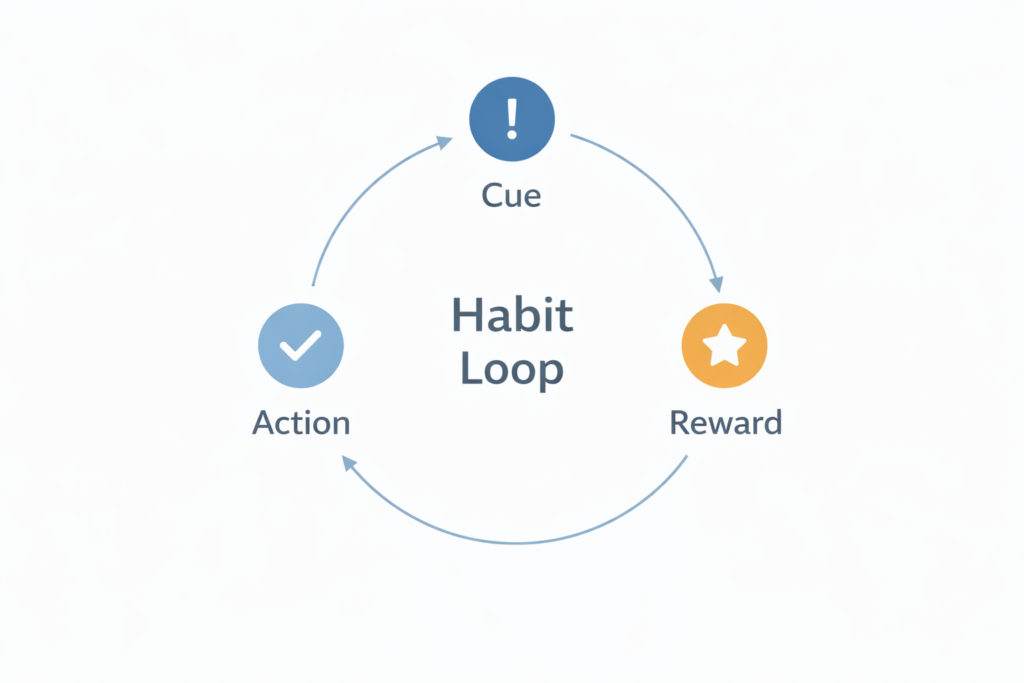
One of the simplest ways to understand habits is through the habit loop.
1. Cue
This is the trigger.
It could be:
- a time of day
- a place
- an emotion
- another action
- a specific situation
Example: feeling stressed after work.
2. Action
This is the behaviour itself.
Example: opening social media, snacking, or going for a walk.
3. Reward
This is what your brain gets from the behaviour.
Example:
- distraction
- comfort
- pleasure
- relief
- satisfaction
If the reward feels strong enough and the loop repeats often, the behaviour becomes easier to repeat in the future.
Real-Life Example of Habit Formation
Imagine two people finish work feeling mentally tired.
Person one:
- sits down
- opens social media
- scrolls for an hour
- feels temporary relief
Person two:
- changes clothes
- goes for a 15-minute walk
- feels calmer afterwards
If repeated often enough, both behaviours can become habits.
The difference is not that one person has a “better brain”. The difference is what each brain has been trained to repeat.
How Habits Change Your Life Over Time
People often underestimate habits because daily actions seem too small to matter.
But life is heavily shaped by repeated behaviour.
A small action done once has little effect. A small action repeated for months or years can completely change your direction.
Habits influence:
- health
- productivity
- relationships
- finances
- mood
- confidence
For example:
- a daily walk improves energy and fitness
- regular saving builds financial stability
- reading every day improves focus and knowledge
- going to bed on time improves sleep and mood
The opposite is also true.
- daily overspending hurts finances
- constant distraction weakens focus
- poor sleep affects energy and mental clarity
- avoidance increases stress over time
Your habits become your direction.
How to Build Better Habits
Knowing the science is useful. Using it in real life is what matters.
Start smaller than you think you need to
One of the biggest mistakes people make is starting too big.
Instead of:
- exercise for one hour every day
Start with:
- 10 minutes of movement
Instead of:
- read 30 pages every night
Start with:
- read two pages
A small habit is easier to repeat, and repetition is what trains the brain.
Attach the new habit to something you already do
This makes the habit easier to remember.
For example:
- after brushing your teeth, stretch for two minutes
- after making coffee, write your top task for the day
- after dinner, go for a short walk
This works because an existing routine becomes the cue for the new behaviour.
Make the habit easy to start
Reduce friction.
Examples:
- leave your trainers by the door
- keep a book on your bedside table
- prepare healthy food in advance
- put your phone away before bed
The easier it is to begin, the more likely you are to repeat it.
Focus on consistency, not perfection
You do not need to do the habit perfectly.
You need to keep doing it.
A short workout still counts.
A short reading session still counts.
A small amount saved still counts.
Consistency shapes the brain more than intensity.
How to Break Bad Habits
Breaking a bad habit usually works better when you focus on the trigger and the environment, not just willpower.
Identify the cue
Ask yourself:
- When does this habit happen?
- What triggers it?
- Is it stress, boredom, location, or routine?
Once you see the pattern, it becomes easier to change it.
Make the bad habit less convenient
Add friction.
Examples:
- remove tempting apps from your home screen
- stop buying snacks you are trying to avoid
- keep your phone in another room while working
- unsubscribe from marketing emails that trigger spending
Replace, do not just remove
It is often easier to replace a habit than to leave an empty gap.
Instead of:
- stress scrolling
Try:
- a short walk
- making tea
- deep breathing
- writing down what is bothering you
The brain still wants relief or reward. Giving it a healthier response works better than pure suppression.
A Practical Example of Behaviour Change
Let’s say you want to stop checking your phone first thing every morning.
Bad habit loop:
- Cue: waking up
- Action: checking your phone
- Reward: stimulation and distraction
Replacement habit:
- Cue: waking up
- Action: drink water and open the curtains
- Reward: feeling more alert and less rushed
At first, the new habit may feel less natural. That does not mean it is wrong. It means your brain is still used to the old loop.
With repetition, the new pattern becomes easier.
Common Mistakes to Avoid
Relying only on motivation
Motivation changes day to day. Habits are built through structure and repetition, not emotion alone.
Changing too many things at once
Trying to overhaul your entire life usually leads to inconsistency.
Start with one habit.
Expecting instant results
Habit change often feels slow in the beginning. That is normal. You are building a new pattern.
Thinking one bad day means failure
Missing one day does not ruin a habit. Repeatedly quitting does.
The goal is to return quickly, not to be perfect.
FAQ
How do habits shape the brain?
Habits shape the brain by strengthening repeated behavioural pathways. The more often you repeat an action, the easier and more automatic it becomes.
How long does it take to form a habit?
There is no single number for everyone. It depends on the behaviour, the person, and how consistently it is repeated. The key is not speed but repetition.
Why are bad habits hard to break?
Bad habits often provide quick rewards such as pleasure, comfort, or relief. If the brain has repeated that pattern many times, it becomes familiar and easier to repeat.
Can you really rewire your brain with habits?
Yes. Repeated behaviour can change how automatic certain actions feel over time. That is why good habits become easier when practised consistently.
What is the best way to build a new habit?
Start small, make it easy, attach it to an existing routine, and focus on repeating it consistently.
Your brain is always learning from what you repeat.
That means your daily habits are never just small routines. They are instructions you keep giving your brain. Over time, those instructions shape how you think, act, and live.
The good news is that this works in your favour too.
If repeated actions can build unhelpful habits, they can also build better ones. Start small, stay consistent, and let repetition do its work. That is how habits shape your brain and change your life.