
Anyone who’s ever had an MRI scan has, without really thinking about it, been inside one of the most advanced pieces of superconducting engineering most people will ever encounter. That enormous, clanking tube works because of coils of wire cooled to within a whisker of absolute zero, carrying current with essentially no resistance at all. It’s an extraordinary piece of physics wearing the disguise of a slightly uncomfortable hospital appointment.

Now imagine that same zero-resistance trick working at room temperature, with no exotic cooling required at all. Electricity could travel hundreds of kilometres through a cable without bleeding energy away as heat. Enormously powerful magnets could run without constant, expensive cooling. Motors could shrink, cables could get leaner, and entire technologies currently locked inside specialist laboratories could start turning up in ordinary infrastructure. That’s the promise behind room-temperature superconductors — materials that could, in principle, carry current with zero electrical resistance under everyday conditions.
Scientists have understood superconductivity for more than a century, and there’s always been a catch: it has needed extreme cold, extreme pressure, or usually both. That’s finally starting to change. Researchers have reported superconductivity at around 298 kelvin — roughly 25°C, genuinely room temperature — in a hydrogen-rich material called LaSc₂H₂₄. The catch this time isn’t temperature. It’s that getting there required pressure approaching what you’d find deep inside a planet. The real prize is still out of reach: a material that superconducts near room temperature, at ordinary pressure, while also being stable, affordable, and actually manufacturable. Get all of that at once, and the consequences would reach well beyond a physics lab.
What Is a Superconductor, Actually?

A superconductor is a material that drops into a special quantum state below a specific temperature, called its critical temperature, or Tc. In an ordinary copper wire, electrons moving through the metal constantly collide with vibrating atoms and tiny imperfections in the material, and those collisions are exactly what creates electrical resistance — which is also why laptops need fans, power cables warm up in use, electric motors lose some of their input energy, and chips get hot under load. When certain materials turn superconducting, that resistance drops to essentially zero, and current can flow without any of the usual energy loss.
Superconductors also display something called the Meissner effect: a superconducting material actively expels magnetic fields from its interior, which is the trick behind those striking demonstrations of a magnet appearing to hover above a cooled superconductor. It’s more than a party trick, too — it’s part of why superconductors can build extraordinarily powerful magnetic systems. Zero resistance alone isn’t quite proof that a newly discovered material is genuinely superconducting, though; researchers generally look for several independent signatures together, the Meissner effect among them, before calling something confirmed.
So How Does Superconductivity Actually Work?
On the face of it, superconductivity shouldn’t really happen. Electrons carry the same negative charge and normally repel each other — yet inside many conventional superconductors, electrons effectively pair up into what are called Cooper pairs. The trick involves the crystal lattice, the orderly arrangement of atoms running through the material: an electron moving through it slightly distorts the lattice as it passes, and under the right conditions that distortion can draw in a second electron. The paired electrons then move through the material collectively, without the normal scattering that causes resistance. This explanation, known as BCS theory, was worked out by John Bardeen, Leon Cooper and John Robert Schrieffer in 1957, and it still holds up well for conventional superconductors.
It gets murkier with many modern high-temperature superconductors, particularly the copper-based materials known as cuprates, whose behaviour doesn’t always fit the standard picture neatly. Exactly why cuprates superconduct the way they do remains a genuinely active area of physics, which is part of why this field keeps throwing up surprises.
Why Is Room-Temperature Superconductivity So Difficult?
Superconductivity is a genuinely fussy state. Push the temperature too high and it collapses; push too much current or too strong a magnetic field through the material and it can break down too. Researchers end up tracking several limits at once: the critical temperature it survives up to, the critical current it can carry, the critical magnetic field it can tolerate, and whether it needs serious pressure to hold the state together at all.
That last one is why a headline-grabbing critical temperature doesn’t automatically mean a useful material. A substance that superconducts at 25°C but needs 250 gigapascals of pressure to do it is a genuine scientific triumph and, at the same time, completely unsuitable for a power cable. One gigapascal is a billion pascals, so 250 GPa works out to roughly 2.5 million times normal atmospheric pressure — the kind of squeeze you only get inside a diamond anvil cell, where a microscopic sample gets crushed between two extremely hard diamond tips.
How Close Are We, Really?
The picture has shifted dramatically over the past decade. Superconductivity was first discovered in mercury in 1911, at only a few degrees above absolute zero, and for most of the century afterwards, extreme cold remained unavoidable.
Then came the higher-temperature breakthroughs. In 2019, researchers reported superconductivity in lanthanum hydride (LaH₁₀) at around 250 K (-23°C) — astonishingly warm by the standards of the time, though it needed roughly 170 GPa of pressure to work. More recently, the hydrogen-rich compound LaSc₂H₂₄ pushed things further still: researchers reported superconducting transitions between roughly 271 and 298 K, genuinely touching room temperature, at pressures around 195 to 266 GPa. It’s a serious result, backed by thirteen reproducible experimental runs from the team behind it — though as with any extraordinary physics claim, it’s currently a preprint, and wider independent replication and formal peer review are still part of how a result like this gets properly established.
A separate, and arguably more immediately useful, development landed in 2026. Researchers at the University of Houston reported superconductivity at 151 K (around -122°C) at ordinary, ambient pressure, in a pressure-treated version of a mercury-based cuprate, HgBa₂Ca₂Cu₃O₈+δ. Rather than keeping the material under pressure permanently, the team squeezed it and then released that pressure rapidly in a technique called pressure quenching, which locks in an enhanced superconducting state even after the pressure disappears. That beat the previous ambient-pressure record of 133 K, a figure that had stood since 1993 — more than thirty years. It’s still a long way below room temperature, but it’s a genuinely significant jump in exactly the category that matters most for practical use: superconductivity you don’t need a diamond anvil cell to maintain.
Put together, these results have quietly changed the question the field is actually asking. It’s no longer simply “can superconductivity happen near room temperature?” That’s now been shown, repeatedly, under extreme pressure. The real question is whether scientists can make room-temperature superconductivity stable at normal, everyday pressure, in a material anyone could actually manufacture — and that remains unsolved.
What About LK-99?
Worth addressing directly, since it’s probably what a lot of people half-remember from the news. In 2023, a material called LK-99 became a genuine internet sensation after researchers claimed it superconducted above room temperature at ordinary pressure — which, if true, would have been one of the biggest physics stories in decades. Labs around the world rushed to reproduce it. None of them could. Follow-up investigations found that the effects initially read as superconductivity were more plausibly explained by impurities and ordinary magnetic behaviour, and Nature later reported that the evidence ultimately didn’t support LK-99 being a genuine room-temperature superconductor.
It’s a useful cautionary tale for this entire field: a real room-temperature superconductor won’t be established by one dramatic video or a single resistance measurement, however convincing it looks. It takes independent labs reproducing the same material and the same properties, more than once, before a claim like this earns any real trust.
Why Zero-Resistance Electricity Would Matter for Power Grids
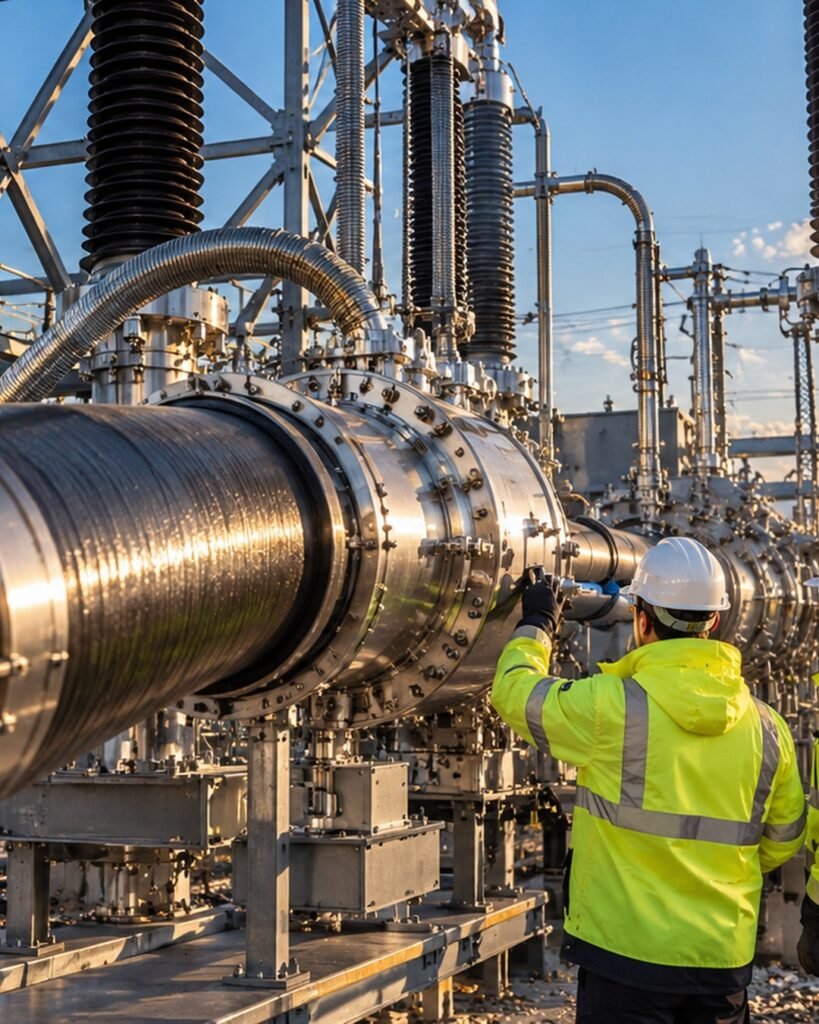
Every modern electrical grid loses energy simply moving power around — the US Department of Energy puts transmission and distribution losses at roughly 6% of all electricity generated in the country, which at national scale is a genuinely enormous amount of wasted energy. Superconducting cables could cut those resistive losses dramatically while carrying very high currents through a noticeably more compact conductor. High-temperature superconducting cables already exist and have been demonstrated carrying around 200 times the current of an equivalent-sized conventional copper cable, according to a US Department of Energy demonstration — they just still need active cooling to work. A room-temperature version could strip out much of that complexity, which would matter most in places like crowded cities where laying new transmission corridors is genuinely difficult, power-hungry data centres, renewable energy networks moving electricity over large distances, and factories running high-current equipment. It wouldn’t make the whole system perfectly efficient — transformers, converters and other equipment would still lose some energy, and even superconductors carrying alternating current have losses of their own — but one of the biggest sources of waste could shrink considerably.
Stronger Magnets, Courtesy of Superconductors
Superconductors already do the heavy lifting anywhere an exceptionally strong, stable magnetic field is required — MRI scanners being the example almost everyone’s encountered directly, alongside particle accelerators and various scientific instruments that lean on the same basic technology. Superconducting magnets are also central to fusion reactor research, where enormous magnetic fields are needed to contain plasma heated to genuinely extreme temperatures. If a comparable superconductor worked without the usual cryogenic cooling apparatus, these systems could become considerably smaller, simpler and cheaper to maintain — a real benefit for medical imaging, fusion experiments, particle accelerators, industrial motors and generators, and magnetic energy storage alike.
Could It Transform Transport, Too?

Magnetic-levitation, or maglev, trains are the other famous example. Superconducting magnets interact with magnetic structures built into the track, letting the train levitate rather than relying purely on wheel-to-rail contact, which cuts mechanical friction at high speed considerably. Japan has spent decades developing superconducting maglev technology, but the cooling equipment superconducting magnets currently need adds real cost and complexity. A practical room-temperature superconductor wouldn’t suddenly make maglev cheap — tracks, tunnels, control systems and power infrastructure would still cost what they cost — but it would remove one genuinely significant engineering headache from the equation.
What About Computing and Quantum Computers?
Computing has its own heat problem worth mentioning here. Billions of transistors switching rapidly, combined with ordinary electrical resistance in wires and components, is a large part of why processors run hot and burn power. Superconducting interconnects could, in principle, move signals with dramatically lower resistive loss than copper manages today.
Superconductors already matter enormously in quantum computing specifically — many companies and research labs build qubits, the quantum equivalent of an ordinary bit, from superconducting circuits. It’s worth being careful here, though: a room-temperature superconductor wouldn’t automatically produce a room-temperature quantum computer. Quantum processors need an extremely controlled environment for reasons that go well beyond plain electrical resistance, and most superconducting qubit systems run close to absolute zero specifically to suppress thermal noise and protect fragile quantum states. A warmer superconductor could remove some of the cooling burden, but plenty of other quantum engineering challenges would remain exactly where they are.
What Would a Genuinely Practical Superconductor Need?
Temperature alone was never going to be enough. A material that could actually go into industrial use would realistically need to tick off several boxes simultaneously: superconduct somewhere around 293–300 K (ordinary indoor temperature), work near normal atmospheric pressure rather than millions of atmospheres, carry large currents without losing its superconducting state, survive strong magnetic fields where needed, stay chemically stable for years, use reasonably abundant raw materials, be manufacturable as wire, tape or thin film rather than a microscopic lab sample, and be reproducible by independent labs rather than just the group that discovered it. That’s precisely why this search is so hard — a microscopic sample briefly superconducting inside a diamond anvil cell is a genuine scientific triumph, and there’s still a vast engineering gap between that and a working kilometre of cable.
How Scientists Are Actually Hunting for Better Materials
Rather than testing candidate materials essentially at random, researchers increasingly pair laboratory experiments with heavy computer modelling, calculating in advance which atomic structures are likely to produce favourable superconducting behaviour before committing to an expensive experiment. Machine learning now helps sift through enormous databases of possible materials to flag the most promising candidates before anyone fires up a diamond anvil cell — a 2026 study, for instance, used machine learning paired with quantum-mechanical calculations specifically to screen hydride materials for possible ambient-pressure superconductors. Pressure quenching, the technique behind the University of Houston’s 151 K result, is a second promising route: compress a material, then release that pressure in a way designed to preserve the favourable atomic arrangement it was squeezed into. The underlying goal across all of this is really materials engineering at the atomic scale — working out exactly which combinations of elements and crystal structures let electrons pair up and superconduct without needing extreme conditions to do it.
Where to Follow This Research Properly
For anyone who wants to follow developments directly rather than wait for the next viral claim, a few solid, freely available resources are worth bookmarking. Google Scholar and arXiv are the best starting points for published research and early preprints respectively; in the US, APS Physics offers accessible coverage from the American Physical Society, and the DOE Office of Science regularly publishes updates on superconductor and quantum materials research. For anyone wanting to dig into the raw data, the Materials Project offers calculated properties for thousands of materials, and Quantum ESPRESSO is open-source software used for quantum materials simulation. One habit worth building: treat a preprint as interesting rather than settled. Early postings on platforms like arXiv are genuinely useful for spotting a result early, but peer review and independent replication are still what separates a promising claim from an established fact — LK-99 is the clearest recent reminder of why that distinction matters.
Frequently Asked Questions
Do room-temperature superconductors already exist?
Superconductivity near room temperature has been reported in hydrogen-rich materials such as LaSc₂H₂₄, with transitions reaching about 298 K — but only under pressures of hundreds of gigapascals. A practical material that’s both room-temperature and ambient-pressure, independently confirmed, hasn’t been found yet.
What’s the highest-temperature superconductor at normal pressure?
As of 2026, that’s 151 K (about -122°C), reported by University of Houston researchers in pressure-quenched HgBa₂Ca₂Cu₃O₈+δ — a record that had previously stood at 133 K for more than thirty years.
Why do superconductors have zero electrical resistance?
Electrons inside a superconductor can form collective quantum states — Cooper pairs, in conventional superconductors — that move through the material without the ordinary scattering responsible for electrical resistance.
Would superconducting power lines waste literally no electricity?
The superconducting cable itself could eliminate ordinary resistive losses in direct current, but the wider grid would still lose some energy in transformers, converters and cooling systems, and AC superconducting systems have losses of their own too.
Was LK-99 ever confirmed as a room-temperature superconductor?
No. Independent testing found no convincing evidence to support the original claim — the unusual resistance and magnetic behaviour observed turned out to be explainable without invoking superconductivity at all.
The Real Breakthrough Is Still Ahead
This search has come a lot further than most people probably realise. Researchers have reported superconductivity brushing up against 298 K under extreme pressure, while the ambient-pressure record has climbed to 151 K. Neither achievement, on its own, hands engineers the material they’re actually after.
The genuinely transformative discovery would need to combine every important property at once: room-temperature operation, ordinary pressure, high current capacity, strong magnetic-field tolerance, long-term durability, and manufacturing that’s actually economical. Reaching that wouldn’t instantly replace every copper wire on the planet or reinvent every machine overnight. It could, gradually, reshape power grids, electric motors, medical equipment, scientific instruments, transport systems, and parts of computing, piece by piece.
For well over a century, superconductivity has shown physicists exactly what electricity is capable of once resistance disappears from the equation. What’s left is making that extraordinary behaviour work under the thoroughly ordinary conditions of everyday life.