
The other day I searched for something perfectly ordinary and got five articles back. All five said the same thing, in almost the same words, in the same order. Not one told me anything the others hadn’t. It felt less like reading the internet and more like overhearing it talk to itself.
It turns out that isn’t just my imagination, and it points to one of the stranger problems in artificial intelligence. AI learned to write by reading us: books, forums, news stories, Wikipedia, research papers, software manuals and billions of other things people wrote. Now it’s producing enormous amounts of text of its own, and that text is landing on the very internet that future AI will learn from.
So the loop looks like this: AI writes, the web fills up, the next AI reads the web, and then writes even more.
Here’s the important bit. The internet is not running out of words. What’s running short is new, good-quality, human-written words, while machine-made text can be produced almost without limit. That difference could shape the next generation of AI more than almost anything else.
What Does “AI Training on AI” Actually Mean?

It means using text, images or code created by one AI to teach another. The technical name is synthetic data, and it isn’t automatically a bad thing. Used carefully, it’s genuinely useful, and AI companies openly use it for things like generating extra practice examples or covering languages where there’s little human writing to learn from.
The trouble starts when machine-made text seeps into training data unchecked, with nobody tracking where it came from and less and less original human material to balance it out.
Picture it in stages. People write a million documents. The first AI learns from them, then produces ten million more, and those pages spread across the web. The next AI collects the web, human and machine text all mixed together, and produces hundreds of millions of pages of its own. Each generation learns a little less from us and a little more from the one before.
What Is Model Collapse?
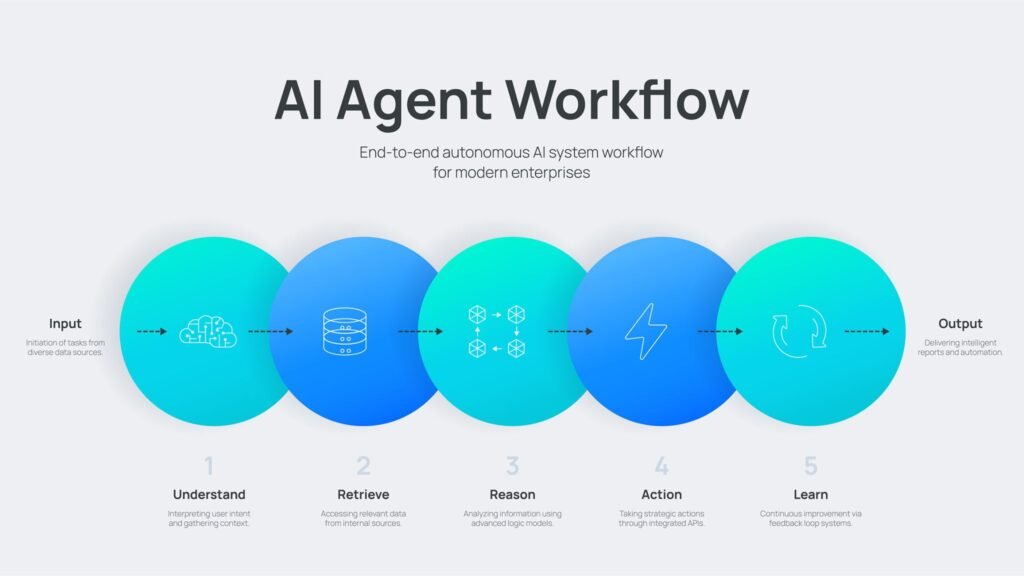
Researchers have a name for what can go wrong: model collapse. It’s what happens when AI systems are trained again and again on AI-generated data and gradually lose their grip on the real world they were meant to learn from.
The best-known evidence comes from a 2024 study in the journal Nature. Researchers repeatedly trained models on the output of the previous generation and watched what happened. Over successive rounds, the models lost track of the less common parts of the original data, and their output became narrower and more distorted.
Think of photocopying a photocopy. The first copy looks almost identical to the original, and the tenth is still perfectly readable. But keep going and the tiny flaws pile up while the fine detail quietly disappears.
The rare stuff goes first. Imagine a dataset where nearly everything is ordinary, but a tiny slice is unusual and completely valid: an obscure dialect, a rare medical presentation, a niche coding trick. A model learns the overall pattern without reproducing every detail perfectly, so those rare examples show up slightly less often in its output. When that output becomes the next model’s training material, they show up even less often. After a few rounds, the model’s picture of the world isn’t nonsense, just narrower, blander and more average.
The same research also found something encouraging. Keeping a share of the original human data in the mix slowed the damage, which is one reason authentic source material still matters so much.
So Is the Internet Really Running Out of Words?
No, but quantity and usefulness aren’t the same thing. AI developers need text that is varied, accurate, original, legally usable, and different from what the model has already seen. A billion near-identical product descriptions doesn’t help.
Epoch AI, a research group that tracks AI trends, estimated in 2024 that the “effective” stock of good-quality public human writing is around 300 trillion tokens, with a wide margin of error (somewhere between 100 trillion and 1,000 trillion). A token is just a small chunk of text, often a word or part of one. If AI training keeps growing at its recent pace, Epoch projected that the biggest models could use up most of that stock somewhere between 2026 and 2032.
We’re now inside that window. But it isn’t a cliff edge where the words suddenly vanish. It’s more like a well that gets harder to draw from. The best, freshest, most accessible material has largely been used already, and finding more of it gets slower and more expensive every year.
Meanwhile, the Web Is Filling Up With AI Text
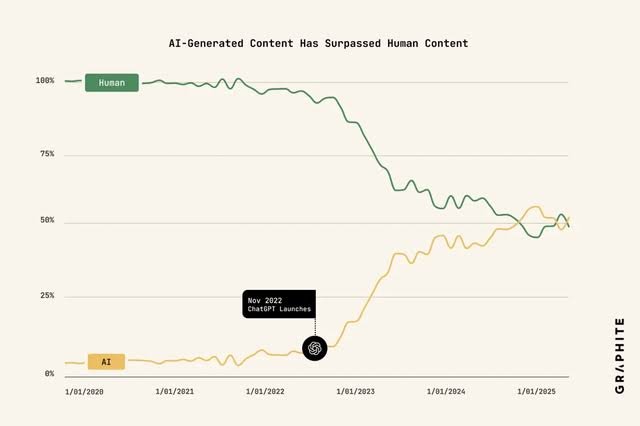
There’s a second complication. The internet that AI companies collect from today isn’t the internet that existed before ChatGPT.
In August 2026, the Pew Research Center published an analysis of 490,000 English-language webpages sampled from Common Crawl, a huge public archive of the web that many AI datasets draw on. Using an AI-detection tool, they found that around 10% of pages in their July 2026 sample showed significant signs of AI writing or heavy AI editing. Before ChatGPT arrived, the figure was about 1%.
Among pages Pew could date to after ChatGPT’s launch in November 2022, roughly 35% showed those signs. There’s an important caveat, though: only 10–15% of webpages carry a readable publication date, so that figure describes dated pages, not the whole web. The picture also varies a lot by type of site. In 2026, roughly one in ten commercial .com pages showed signs of AI authorship, compared with about one in twenty .org pages and around one in a hundred .edu and .gov pages. A separate 2026 study using Internet Archive data landed in a similar ballpark, estimating that about 35% of newly published websites by mid-2025 contained AI-generated or AI-assisted text.
Pew is careful to point out that AI detectors are imperfect. They’re better at describing large collections of pages than judging any single one, and they also flag heavily AI-edited writing, not just text written from scratch. So treat these as good estimates, not exact counts. The direction of travel, though, is clear: every year it gets harder to tell wholly human writing from the machine-assisted kind.
Can’t AI Companies Just Re-Read the Old Stuff?
They can, and they do. Carefully repeating high-quality material can still improve a model. But there are limits.
Think of a student revising with 1,000 textbooks. Reading the best ones twice will probably help. Reading the same books a hundred times won’t give you a hundred times the knowledge. To keep improving, you eventually need something new: harder problems, specialised material, feedback from real users, or fresh evidence from the physical world. It’s one reason the industry is talking less about how many trillions of tokens a model has seen and more about how good those tokens are.
Synthetic Data Isn’t the Villain
It would be easy to walk away from all this thinking that AI-made data is poison. It isn’t. It’s a tool, and it depends how you use it.
Say an AI is learning maths. Rather than hunting the internet for another million algebra questions, developers can generate problems aimed at exactly the topics the model finds hardest, and check every answer is correct before it goes in. A stronger model can even act as a teacher, producing examples for a smaller one. Done well, synthetic data can supply rare examples, balance out under-represented topics, cover more languages, and reduce reliance on sensitive personal information.
The difference is between a teacher writing carefully checked practice questions, and a student copying homework from a classmate who copied it from another classmate. Same kind of material, completely different reliability.
How Can Developers Avoid the Feedback Loop?
There’s no single fix. Future training will probably combine several approaches:
- Protect the human data. High-quality, genuinely human datasets are becoming more valuable, and keeping them in the mix (rather than replacing them with synthetic versions) helps limit degradation.
- Filter more aggressively. Training pipelines can try to weed out duplicates, spam, mass-produced SEO pages, copied articles and low-quality machine writing, and concentrate on smaller, better collections.
- Track where data came from. This is called provenance. Some researchers compare text published before the generative-AI boom to “low-background steel”, metal made before the first nuclear tests, which is prized for sensitive instruments because everything made afterwards carries a faint trace of contamination. Pre-ChatGPT writing is similarly useful as a trusted reference.
- Verify synthetic data. Generated code can be run to see if it works, maths answers can be calculated independently, and factual claims can be checked against trusted sources. That turns synthetic data into something carefully manufactured rather than uncontrolled internet noise.
Will Human Writing Become More Valuable?
Probably, at least the kind AI can’t cheaply invent. Compare these two headlines:
“Five ways to improve workplace productivity.”
“We tested four warehouse picking systems across 18 sites for six months. Here are the results.”
AI can churn out endless variations of the first. It can’t independently recreate the second without someone having actually run the experiment.
I work in fulfillment, and the most useful things I know (why a line jams, which fix actually holds) I didn’t get from anything written down. I got them by standing next to the problem. That kind of knowledge doesn’t exist in any dataset until a person writes it down.
The scarce resource, then, may not be human words. It may be new human observations about the real world: first-hand experience, original research, interviews, measurements, experiments, investigative reporting, specialist expertise, and fresh photographs and recordings.
What This Means If You Run a Blog or Website
If you publish online, this is good news as well as a warning. Another generic article, stitched together from what 5,000 other sites already say, adds almost nothing. What stands out is something original that only you can supply.
A laptop review is a good example. Instead of rewording the manufacturer’s spec sheet, you could include the battery life you actually measured, how hot it got under load, photographs you took yourself, and the problems that only showed up after a month of real use. AI can still help you organise, edit or explain all of that. But the information itself should come from reality, not from another AI’s summary of a summary.
FAQ
Can AI be trained on AI-generated content?
Yes. Synthetic data can work very well when it’s deliberately generated, filtered and checked. Problems are more likely when models learn again and again from uncontrolled machine-made material while the original human data drops out of the mix.
What is model collapse in AI?
It’s a gradual loss of quality that can happen when successive AI models are trained heavily on data produced by earlier models. Rare details from the original data fade away, so the model’s picture of the real world becomes narrower and less accurate.
Is the internet actually running out of human-written text?
Not literally. People are still writing vast amounts. The limited resource is distinct, high-quality, publicly available human text that’s suitable for ever-larger AI training runs. Estimates suggest the biggest models could use up most of it sometime between 2026 and 2032.
How much online content is AI-generated?
Nobody knows exactly. A Pew Research Center analysis published in August 2026 estimated that about 10% of English-language webpages in its July 2026 sample showed significant signs of AI authorship or editing, with a much higher share among pages published since ChatGPT launched. AI detectors are imperfect, so these are estimates rather than precise counts.
Will AI eventually learn only from other AI?
Almost certainly not entirely. Developers can preserve human datasets, license new material, collect feedback from real people, learn from images, audio and video, and generate carefully checked synthetic data. The challenge is keeping a strong connection to original human knowledge and real-world evidence.
The Internet’s Most Valuable Resource May Be Originality
For the first time, machines can produce readable text far faster than people can. That doesn’t make human writing irrelevant. If anything, it makes it more important.
As AI-generated pages multiply, future models will need better ways to tell original evidence from recycled machine output, which means stronger filtering, better provenance tracking, carefully verified synthetic data and continued access to real human knowledge.
The internet isn’t running out of words. It’s filling up with words that are cheaper than ever to make. The genuinely scarce thing is new information grounded in human experience and the real world, and the better AI gets at writing, the more that will matter.