

Classic tools such as books, notebooks, clocks, cameras, and telephones show why simple technology can remain useful for decades.
You often hear people say, “We live in the 21st century, not the 1950s.” It usually implies that we are at our most civilised, efficient, and technologically advanced point in human history.
But what if I told you that a plethora of old inventions and technologies still cannot be beaten by 21st-century gadgets? Despite billions in R&D, we simply haven’t produced anything better for certain tasks.
Here are 16 old-school inventions that remain undefeated in modern times—and the very last one will make you stop and think!
1. Fountain Pen
Unlike styluses or ballpoints that require constant downward pressure, a fountain pen relies on capillary action, allowing ink to flow effortlessly across paper. It reduces hand fatigue during long writing sessions, improves ergonomics, and lasts for decades or even generations. Plus, it never needs a battery, a Bluetooth connection, or a firmware update.
2. COBOL Programming Language
Created in 1959, COBOL (Common Business-Oriented Language) still quietly powers the global financial system. It was designed specifically for business data processing and excels at exact fixed-point decimal Math—something modern floating-point programming languages can struggle with without extra libraries. It is ridiculously reliable, efficient, and capable of processing trillions of dollars in daily transactions without crashing.
3. Magnetic Stripes
While smart chips and contactless NFC get all the hype, the simple magnetic stripe on the back of cards remains unbeatable in cost and utility. It costs fractions of a cent to manufacture, requires no microchips, and works instantly for hotel keycards, transit passes, and loyalty programs without needing an internet connection at the reader level.
4. Paper

Paper has zero boot time, infinite battery life, and total immunity to cyberattacks or cloud outages. Studies consistently show that writing on paper improves memory retention and cognitive processing compared to typing. It offers complete freedom—you can sketch, write, highlight, and cross out instantly without navigating app menus or dealing with screen fatigue.
5. Dot-Matrix Printer
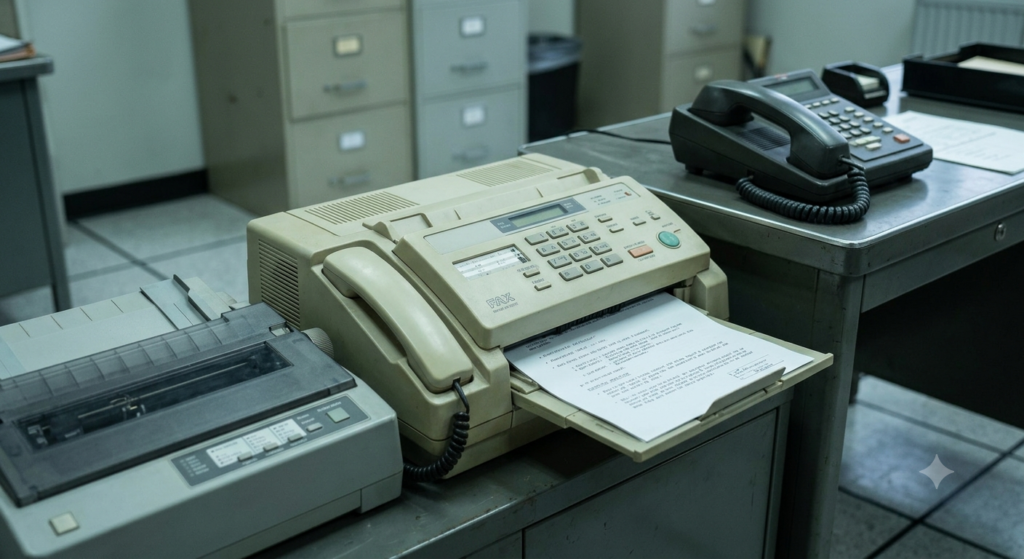
Modern inkjet and laser printers cannot exert physical impact. Dot-matrix printers use physical pins to strike an ink ribbon, making them the only technology capable of printing multi-part carbon copy forms (like shipping manifests, invoices, and receipts) in a single pass. They are also rugged workhorses that thrive in dusty industrial environments where laser printers would quickly fail.
6. Fax Machine
In healthcare, law, and government, faxing remains a dominant form of document transmission. Because it operates over direct, point-to-point phone lines, it creates an immediate physical audit trail and confirmation receipt. Legally, faxed signatures are widely accepted as binding originals, whereas standard email can easily be intercepted, spammed, or altered.
7. Phone Landlines
Traditional copper wire landlines (POTS – Plain Old Telephone Service) carry their own low-voltage power directly from the telephone exchange. This means landlines continue working during major power outages or natural disasters when cell towers get overloaded or lose electricity. They also provide crystal-clear voice clarity without dropped calls or signal dead zones and automatically pinpoint your exact physical location to emergency services.
8. Newspapers
A physical newspaper offers something modern news feeds lack: a defined beginning and end. Curated by professional editors rather than engagement-driven algorithms, newspapers deliver a balanced snapshot of world events without infinite scrolling, pop-up ads, or outrage-inducing clickbait. When you finish reading a newspaper, you are informed—not drained.
9. Checkbooks
For large payments—such as rent, contractor deposits, or business transactions—electronic transfers often incur hefty processing fees or daily wire limits. A check allows you to transfer large sums securely without digital fees, scheduled automatically on paper, and serving as a legally undeniable proof of payment once cashed.
10. Paper Calendar
Wall and desk calendars offer ambient, at-a-glance visibility for an entire household or office. You don’t need to open an app, unlock a device, or sync accounts to see what’s happening this week. Physical calendars sit in your environment, creating a shared spatial awareness of time that digital calendar notifications simply cannot match.
11. Vinyl Records
Digital audio files (like MP3s or compressed streams) work by taking snapshots of sound and discarding frequencies the human ear supposedly can’t hear. Vinyl records, however, store sound as a continuous, physical analog groove. The result is a richer, warmer, and more authentic reproduction of sound. Beyond audio quality, vinyl turns music listening back into an intentional, tactile ritual.
12. Physical Books
Physical books don’t track your reading data, display push notifications, or suffer from Digital Rights Management (DRM) issues where a company can pull a title from your library. You truly own a physical book—you can lend it to a friend, annotate it, display it on a shelf, and read it under direct sunlight without screen glare or eye strain.

13. Mechanical Watches
Smartwatches become obsolete in 3 to 5 years when their lithium batteries degrade and software updates stop. A high-quality mechanical watch is powered purely by a wound spring or the kinetic movement of your wrist. Containing hundreds of microscopic gears working in harmony, a mechanical watch can run for centuries with basic maintenance, serving as both a distraction-free tool and an heirloom.
14. Cash
Cash is the ultimate tool for financial privacy, budgeting, and independence. It leaves no digital footprint, cannot be hacked or tracked, and requires no banking infrastructure or electricity to complete a transaction. Psychologically, spending physical cash creates tactile friction, making you significantly less likely to overspend compared to tapping a card or phone.
15. Printed Photos
Thousands of digital photos rot forgotten in cloud storage or lost phone backup drives. A printed photograph turns a fleeting digital frame into a permanent physical object. Printed photos don’t disappear when an account gets locked or a hard drive fails; they sit in albums and frames, preserving family history in a way that feels meaningful and enduring.

16. Real-Life Conversations and Dating

We spent the last two decades building algorithms to connect us, only to end up more isolated than ever. Modern dating apps and messaging platforms flatten human connection into text bubbles, filtered photos, and gamified swiping mechanics. But no algorithm can calculate micro-expressions, tone of voice, shared laughter, or the immediate, electric chemistry of sitting across from someone in the real world.
What makes this one hit differently is the paradox: in an era of hyper-connectivity, the ultimate “old school” technology we can’t seem to replace is simply human presence. We traded face-to-face interaction for digital convenience, only to realize that the most advanced tech in the world still can’t recreate genuine human warmth.
FAQ
Is old technology really more durable than modern gadgets?
Yes, in many cases. Simple mechanical tools and analogue formats lack fragile microchips, software bloat, and degrading lithium-ion batteries. With proper care, items like mechanical watches, fountain pens, and vinyl records can function for decades or centuries.
Why do financial systems still rely on COBOL instead of modern programming languages?
COBOL was optimised specifically for exact, fixed-point decimal arithmetic, making it incredibly precise for financial transactions. Upgrading millions of lines of proven, highly reliable legacy code carries immense cost and risk for banks.
Is returning to analog tools cheaper in the long run?
Absolutely. Analog tools usually involve a single one-time purchase without monthly subscription fees, required software upgrades, or planned obsolescence, making options like paper notebooks, physical books, and cash budgeting far more cost-effective over time.
Conclusion
While modern gadgets promise convenience, they often come at the cost of screen addiction, subscription fees, privacy risks, and rapid obsolescence. Classic, low-tech solutions usually do one job exceptionally well without asking for a charger or a software update.
Beyond their sheer reliability, classical tech is often vastly more affordable. Buying a quality pen and a sturdy paper notebook costs a fraction of the price of an electronic tablet and smart stylus—yet delivers a distraction-free environment that modern technology spends billions trying to emulate. Sometimes, the best tool for the job was invented decades (or centuries) ago.