

Laptop thermal interface showing copper heat pipes and fan assembly.. Source: Olga Grivcova / Getty Images
I once left a laptop rendering a heavy data analysis job overnight during a certification course I was taking. When I checked on it the next morning, it was running noticeably slower despite having plenty of work left to do.
My first thought was that something had crashed. Nothing had. The processor had simply gotten too hot to sustain its max speed and quietly throttled itself back to prevent permanent damage. It was like watching a sprinter drop to a jog halfway through a race just to keep from collapsing.
That small, annoying moment is a neat window into one of the biggest open problems in modern computing.
For decades, making chips smaller pretty much automatically made them faster. Engineers shrank transistors, packed more of them onto a chip, pushed the clock speed higher, and overall performance climbed accordingly. Every new PC generation genuinely felt faster than the last.
Then, somewhere along the way, that stopped being true. Chipmakers can still manufacture transistors at scales that are hard to picture, yet clock speeds have barely moved in years. A modern desktop chip carries tens of billions of transistors, but it runs at roughly the same few gigahertz that felt cutting-edge a decade ago.
It’s not that engineers forgot how to build faster transistors. It’s heat. More precisely, it’s what engineers call the power-density wall: there is only so much electrical power you can pump through a sliver of silicon before getting rid of the resulting heat becomes genuinely difficult.
There is no strict physical law behind the phrase “nanometre heat limit”—it’s really just a shorthand for this thermal problem. Transistors keep shrinking, but the old bargain—smaller transistor, lower power, much higher clock speed—has quietly broken down.
What Does “Nanometre” Actually Mean?
Modern chips get labelled with numbers like 7nm, 5nm, or 3nm. A nanometre is one-billionth of a metre—for scale, a human hair is tens of thousands of nanometres wide, so we are long past human-scale visual intuition.
Years ago, that nanometre number roughly matched a real, measurable feature inside a transistor. These days, it functions more as a marketing generation label than a literal ruler measurement, with different manufacturers defining their own numbers slightly differently. What remains true, however, is the underlying physical trend: engineers keep finding ways to squeeze more sophisticated transistor structures into far less space.
That creates a fascinating problem. Cram more computing machinery into the exact same physical footprint, and you naturally generate far more heat within that same tiny footprint. That is where power density enters the picture.
Power Density, in Plain Terms

Power density and temperature maps showing concentrated logic hotspots./Source: ResearchGate
Power density is simply how much power is being consumed within a given physical area.
Imagine two heaters, each putting out 100 watts. One spreads that heat across a large metal plate. The other pushes the same 100 watts through a surface the size of a coin. The second one is far harder to cool, purely because the thermal output is so concentrated.
Microprocessors face this exact bottleneck. Billions of transistors switch on and off constantly, and every single switch costs a tiny amount of electrical energy—individually, almost nothing. But billions of transistors switching billions of times every second quickly adds up to real power. That power eventually turns into raw heat, all packed into a few square centimeters of silicon.
Getting rid of that heat fast enough has become one of the single biggest bottlenecks limiting how fast a chip can actually run.
Why Higher Clock Speeds Mean Exponentially More Heat
A chip’s clock speed represents how many timing cycles it runs through each second—a 4GHz processor completes around four billion cycles a second. Push that number up, and the chip can, in principle, complete more operations per second.
But higher frequencies come at a steep electrical cost. The active power a chip burns depends heavily on three key variables:
| Variable | Mechanical Role | Impact on Heat & Power |
| Capacitance ($C$) | Electrical charge shifted during circuit switches | Linear increase in power draw |
| Frequency ($f$) | Number of switching cycles per second (Clock Speed) | Linear increase in power draw |
| Voltage ($V$) | Electrical “pressure” pushing current through circuits | Quadratic increase ($P \propto V^2 f$) |
Push the frequency up, and power consumption rises linearly. But to keep those ultra-fast switching operations stable, you often have to increase the operating voltage as well. Because power scales with the square of the voltage, even a tiny voltage bump produces a disproportionately massive surge in power draw and heat.
The Rule That Made the Old Golden Age Possible
For a good stretch of computing history, the industry rode something called Dennard scaling, named after IBM researcher Robert Dennard.
The idea was elegantly simple: as transistors got smaller, you could also lower their operating voltage. Smaller transistors consumed less energy individually while more of them fitted into the same space—meaning transistor density went up without power density spiralling out of control.
| Era | Scaling Principle | Industry Outcome |
| 1985 – 2005 | Dennard Scaling Active | Clock speeds increased by over 200x without thermal meltdown |
| 2005 – Present | Dennard Scaling Breakdown | Voltage floor reached; clock speeds plateaued around 3–5GHz |
Between 1985 and 2005, microprocessor clock speeds enjoyed an extraordinary exponential run. The trouble started in the mid-2000s when operating voltage hit a physical floor. Pushing voltage any lower risked transistors becoming unreliable and misfiring. Transistors could still get smaller, but their power appetite was no longer shrinking at the same pace. The industry had run headlong into what engineers call the power wall.
Leakage Makes It Worse
There is a second complication. Modern transistors don’t only use power when they are actively switching—some current escapes even when a transistor is switched off entirely. This is called leakage current.
At atomic scales, keeping electrons exactly where you want them gets genuinely difficult. Quantum tunnelling effects and microscopic insulating layers allow current to sneak through regardless. That leaked current does zero useful computing work—it turns straight into waste heat.
| Thermal Stage | Operational Effect | System Result |
| 1. Temperature Spike | High operating temperatures weaken gate insulation | Increased electron leakage |
| 2. Wasted Current | Non-switching current escapes through gates | Unproductive electrical draw |
| 3. Thermal Runaway | Leaked current generates additional waste heat | Escalating heat-leakage feedback loop |
Unhelpfully, heat makes leakage worse, which creates even more heat. It’s a thermal feedback loop nobody wants: more power leads to more heat, more heat leads to more leakage, and more leakage wastes even more power.
Why Chips Don’t Simply Run at 20GHz
This is probably the most common misunderstanding about processors. A 20GHz chip isn’t impossible because silicon mysteriously stops working past a certain speed—individual circuits can switch extremely fast on their own.
The real difficulty is getting an entire chip, containing billions of transistors all switching together, to run at enormous frequencies while staying within practical electrical and thermal limits.
Imagine doubling a factory’s output by running every single machine twice as fast: production might go up initially, but if every machine draws far more electricity and throws off intense heat, the building’s wiring and cooling system become the actual bottleneck—not the machines themselves. At some point, watts became just as important as gigahertz.
Thermal Throttling: The Chip Protecting Itself
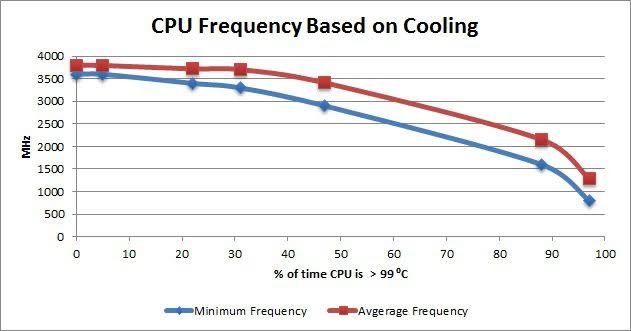
CPU clock frequency drop as thermal throttling engages./ Source: Puget Systems
This was the mechanism behind my laptop’s overnight slowdown. Modern chips constantly monitor their own temperature, current draw, and power consumption. When there is thermal headroom to spare, they briefly boost their clock speed—that is what “turbo” modes are doing.
However, that extra speed is conditional. Processor architectures actively monitor package temperature and power draw; once those safety limits are reached, clock speeds are automatically pulled back down to keep the silicon from frying.
That automatic step-down is thermal throttling. It’s why a laptop can feel blisteringly fast for the first two minutes of a heavy render or gaming session and noticeably slower an hour in. The silicon is fully capable of the higher speed—the cooling system just cannot sustain it for the long haul.
More Cores, Instead of Endless Gigahertz
Once pushing clock speed ever higher stopped being practical, chip designers changed tack. Rather than making a single processing core dramatically faster, they started putting several independent cores on the same chip.
Instead of relying on one super-fast worker, you get a team of workers running side by side. This is why modern consumer CPUs ship with 8, 16, 24, or more cores.
| Compute Workload | Core Scaling Behaviour | Speedup Realised |
| Parallel Tasks (Video Rendering, 3D Graphics, AI) | Work splits cleanly across all cores | Scales dramatically with core count |
| Serial Tasks (Single-thread logic, legacy scripts) | Dependent on a single execution chain | Unaffected by extra cores |
The catch is that software must know how to split its workload across that team. Some tasks divide up easily, while others require step one to finish before step two can start. For serial tasks, adding extra cores offers virtually no speedup.
Even Multiple Cores Hit a Heat Ceiling (“Dark Silicon”)
Adding cores doesn’t make the power problem disappear either. If every transistor on an increasingly crowded chip ran flat-out simultaneously, total power draw would blow straight through the system’s thermal envelope.
That is where the concept of dark silicon comes from—portions of a chip that simply cannot all be powered up at the exact same time without breaching power or thermal limits. A chip’s transistor budget can grow faster than its thermal cooling budget, forcing engineers to selectively switch parts of the chip off depending on the task at hand.
So How Do Chips Keep Getting Faster?

Evolution of chip packaging towards 3D-IC and heterogeneous integration.. Source: Semiconductor Engineering
The end of easy clock-speed scaling doesn’t mean progress has stopped—it just means performance gains are coming from more directions at once.
- Specialised Accelerators: Designers build dedicated hardware blocks (like AI neural engines or hardware video decoders) that perform specific tasks using a fraction of the energy a general CPU core would draw.
- Chiplet Architecture: Manufacturers split massive monolithic dies into smaller, specialised pieces of silicon (chiplets) connected inside a single package.
- Advanced 3D Packaging: Stacking memory directly on top of or alongside the logic die cuts down the distance and energy required to shuttle data back and forth.
- Granular Power Management: Micro-controllers dynamically power down unused sections of the chip down to the millisecond.
The overarching goal has quietly shifted from “make the clock faster” to “get maximum useful work out of every single watt.”
The Real Limit Was Never the Nanometres
Semiconductor shrinkage hasn’t stopped—it is genuinely remarkable what fits on a silicon wafer today. But smaller transistors no longer guarantee the massive clock-speed jumps earlier generations enjoyed almost for free.
The real constraint was never transistor size on its own. It is how much electrical energy—and the waste heat that comes with it—can realistically be dissipated within an impossibly small physical area.
Future chips will continue to get more capable, but those leaps will come from smarter architecture, specialised accelerators, chiplet packaging, and genuine architectural efficiency gains rather than a brute-force sprint toward 10, 15, or 20GHz. Engineers already know how to build astonishingly small machines; the harder problem now is stopping those machines from cooking themselves.