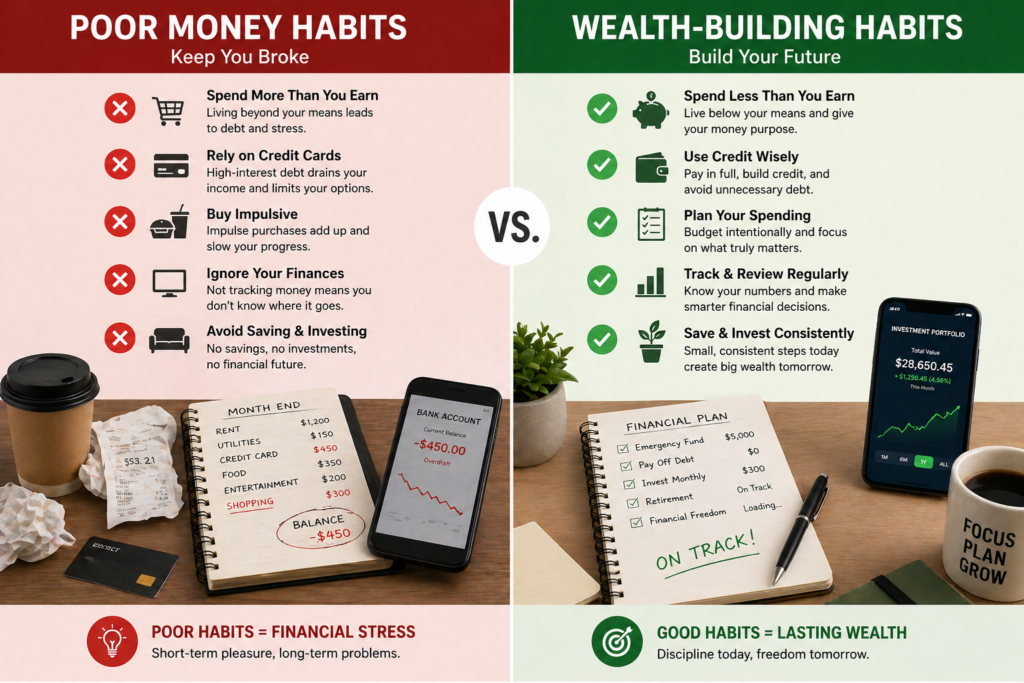

Building wealth isn’t about earning a huge salary—it’s about consistent habits.
Small financial decisions, repeated daily or weekly, can turn into thousands of dollars over time. The difference between struggling financially and building wealth often comes down to simple, repeatable money habits.
What Are Money Habits?
Money habits are the regular behaviours that influence how you earn, spend, save, and invest money.
These include:
- Saving regularly
- Tracking expenses
- Avoiding unnecessary debt
Simple definition:
Money habits are the daily actions that shape your financial future.
Why Simple Money Habits Matter
Small habits compound over time.
Example:
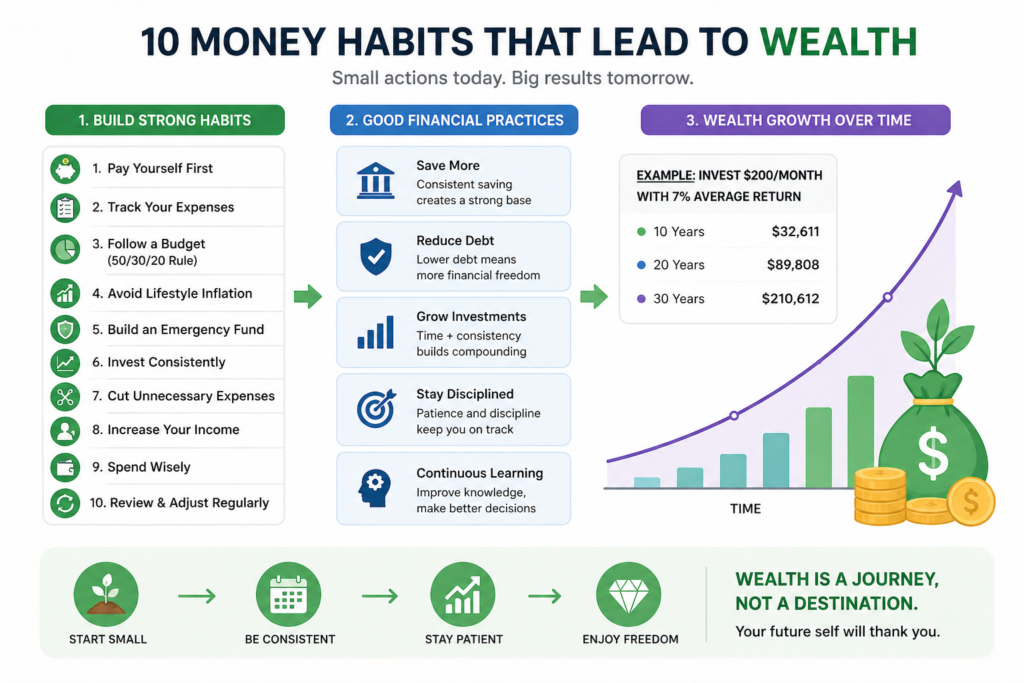
Saving $200/month with a 7% return can grow to:
- ~$3,000 in 1 year
- ~$15,000+ in 5 years
Consistency beats intensity when building wealth.
10 Simple Money Habits That Build Wealth
1. Pay Yourself First
Save before spending anything.
How to do it:
- Automatically transfer 10–20% of your income
Example:
If you earn $2,500/month, save $250–$500 immediately.
2. Track Every Expense
You can’t manage what you don’t track.
Example:
- Track spending for 30 days
- Identify where $100–$300 is being wasted
3. Follow a Simple Budget
Use a system like 50/30/20:
- 50% needs
- 30% wants
- 20% savings
4. Avoid Lifestyle Inflation
As income increases, don’t increase spending at the same rate.
Example:
If your income rises by $500/month, save or invest at least $300 of it.
5. Build an Emergency Fund
Save for unexpected expenses.
Target:
- $1,000–$3,000 initially
- Then 3–6 months of expenses
6. Invest Consistently
Start early, even with small amounts.
Example:
Invest $100–$300 monthly into index funds for long-term growth.
7. Reduce Unnecessary Subscriptions
Small recurring costs add up.
Example:
Cancel 3 subscriptions at $10 each = save $30/month ($360/year).
8. Increase Your Income Gradually
Wealth grows faster when income increases.
Examples:
- Learn a new skill
- Start a side income
- Negotiate salary
9. Use Cash or Debit for Spending
This reduces overspending.
Example:
Switching from credit to debit can reduce spending by 10–20%.
10. Review Your Finances Weekly
Stay aware and in control.
Simple routine:
- Check spending
- Adjust budget
- Track progress
Time required: 15–30 minutes weekly.
Best Tools to Build Strong Money Habits
🌍 Global Tools
- Mint – track spending and budgets easily
- YNAB – zero-based budgeting system
- PocketGuard – shows safe spending limits
🇺🇸 United States
- Personal Capital – track investments and net worth
- Acorns – invest spare change automatically
- Rocket Money – track subscriptions and bills
🇬🇧 UK / Europe
- Money Dashboard – UK budgeting and tracking
- Emma – track subscriptions and spending
- Plum – automated savings and investing
⚙️ Advanced Users
- Notion – custom finance tracking systems
- Excel – full financial control and analysis
- Google Sheets – free budgeting templates
How to Start Building Wealth (Simple Plan)
Here’s a beginner-friendly plan:
Week 1:
- Track all expenses
- Identify $100–$300 savings
Week 2:
- Set up automatic savings (10–20%)
Week 3:
- Start investing $100–$200
Week 4:
- Review and optimise
This system is simple, repeatable, and effective.

How Much Can These Habits Save You?
Let’s combine small habits:
- Save $200/month
- Cut $100 in expenses
- Invest $200/month
Total improvement: $500/month
That’s:
- $6,000/year
- $30,000+ in 5 years (excluding growth)
Common Mistakes to Avoid
- Trying to do everything at once
- Ignoring small expenses
- Not tracking money
- Giving up too early
Focus on consistency, not perfection.
FAQ
What is the most important money habit?
Paying yourself first (saving before spending) is the most impactful habit.
How much should I save each month?
Aim for 10–20% of your income or at least $100–$300 monthly.
Can small savings really build wealth?
Yes. Consistent small savings grow significantly over time through compounding.
How long does it take to see results?
You can see noticeable improvements within 1–3 months.
Do I need to invest to build wealth?
Yes. Saving alone is not enough—investing helps your money grow.
Conclusion
Wealth isn’t built overnight—it’s built through simple, consistent habits.
Start with:
- Saving regularly
- Tracking spending
- Investing consistently
These small actions create massive long-term results.
Take action today:
Pick one habit from this list and start applying it within the next 24 hours.