
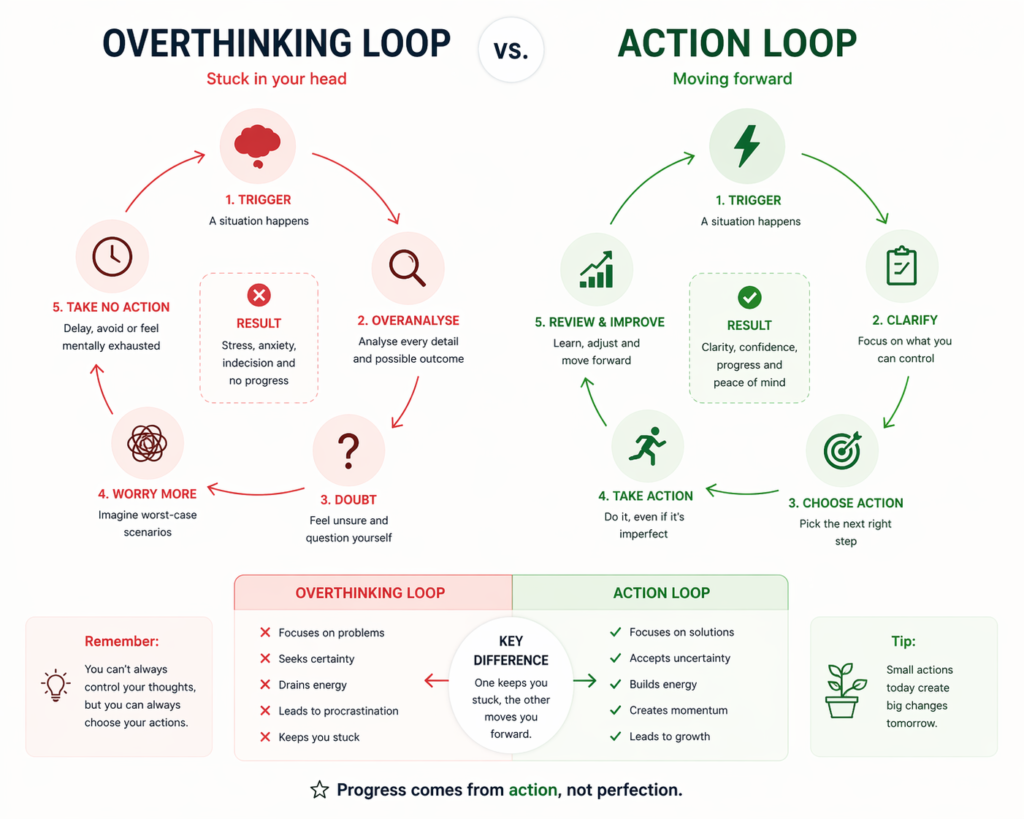
Overthinking can feel like being stuck in a loop you can’t escape. You replay conversations, imagine worst-case scenarios, and struggle to make even simple decisions.
The good news? Overthinking is not a personality trait—it’s a mental habit. And like any habit, it can be trained and improved.
In this guide, you’ll learn why you overthink and practical, science-backed ways to stop it.
What Is Overthinking?
Overthinking is the habit of analysing thoughts, decisions, or situations excessively, often without reaching a conclusion.
It usually shows up as:
- Replaying past events repeatedly
- Worrying about future outcomes
- Struggling to make decisions
- Seeking constant reassurance
Simple definition:
Overthinking is thinking beyond what is useful or productive.
Why Do You Keep Overthinking?
Understanding the cause helps you fix the problem.
1. Fear of Making Mistakes
Your brain tries to “protect” you by analysing every possible outcome.
Example:
Spending 30–60 minutes deciding on a simple email because you fear saying the wrong thing.
2. Need for Control
Overthinking creates an illusion of control over uncertain situations.
Example:
Planning every detail of a future event that may never happen.
3. Perfectionism
You delay decisions because you want the “perfect” choice.
Example:
Spending hours choosing between options that differ very little.
4. Anxiety and Stress
Stress increases mental noise, making it harder to think clearly.
Example:
Thinking about work problems repeatedly even after finishing your shift.
How Overthinking Affects Your Brain
Overthinking isn’t just annoying—it impacts your mental performance.
It can:
- Reduce focus and productivity
- Increase stress hormones
- Cause decision fatigue
- Lower confidence over time
Example:
Spending 2–3 hours overanalysing decisions can drain your energy for the rest of the day.
How to Stop Overthinking (Step-by-Step)
1. Use the “5-Minute Rule”
Limit how long you think about a decision.
How it works:
- Give yourself 5 minutes to think
- Make a decision immediately after
Example:
Choosing what to eat, what to write, or how to reply to a message within 5 minutes.
This reduces decision fatigue instantly.
2. Turn Thoughts Into Actions
Overthinking thrives on inaction.
Instead of thinking:
- “What if this goes wrong?”
Do this:
- Take one small action immediately
Example:
If you’re overthinking starting a project, work on it for just 10 minutes.
Action breaks the thinking loop.
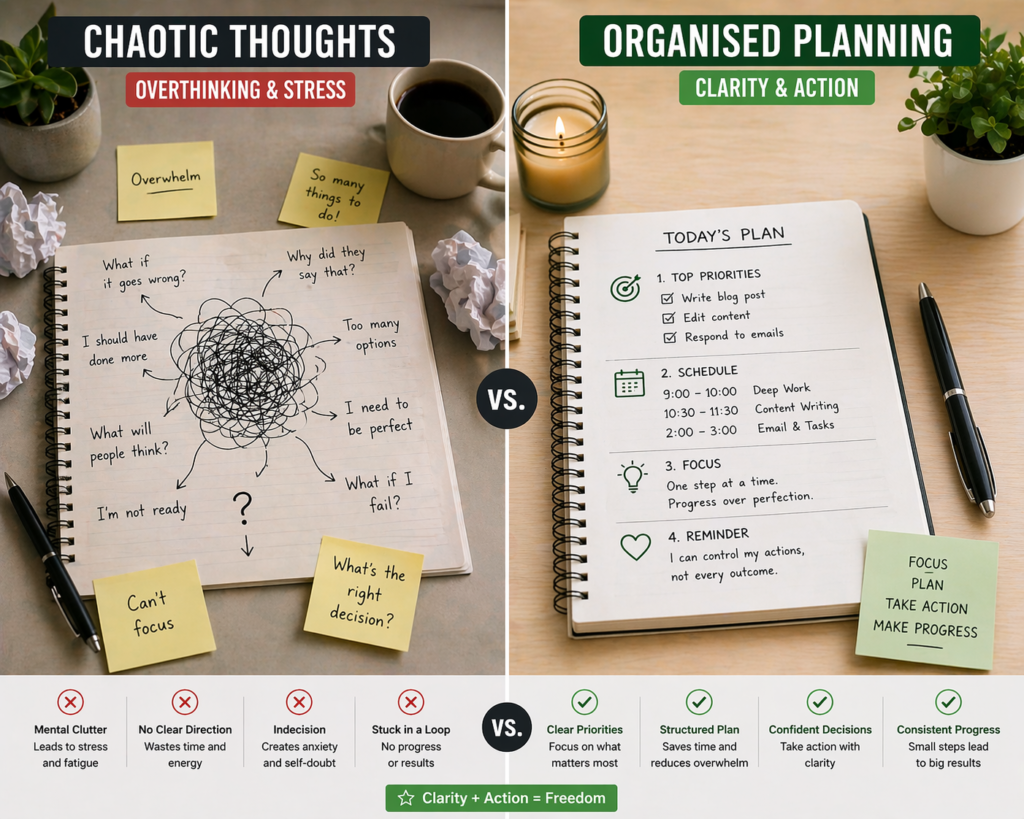
3. Write Your Thoughts Down
Journaling helps you externalise thoughts instead of keeping them in your head.
Simple method:
- Write down the problem
- List 2–3 possible solutions
- Choose one
Example:
Instead of thinking for 1 hour, spend 10–15 minutes writing and deciding.
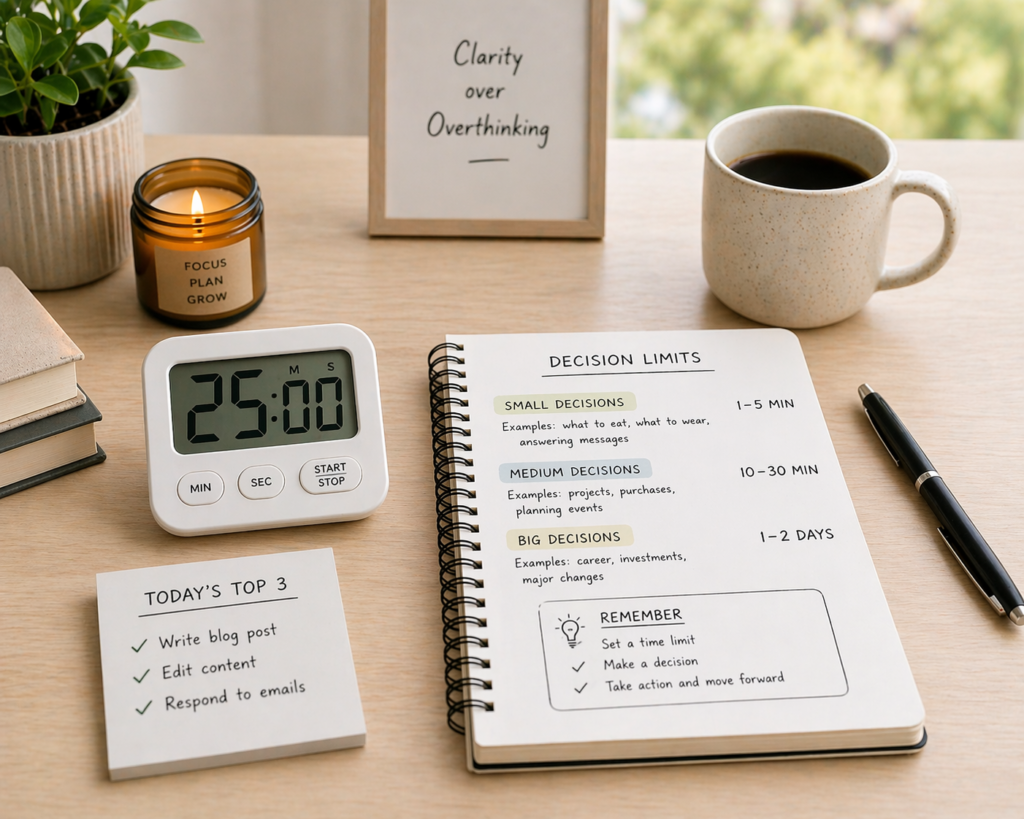
4. Set Decision Limits
Not all decisions deserve equal time.
Use this rule:
- Small decisions → 1–5 minutes
- Medium decisions → 10–30 minutes
- Big decisions → 1–2 days max
This prevents overthinking simple choices.
5. Accept “Good Enough”
Perfection is the enemy of progress.
Example:
A 70–80% good decision made quickly is often better than a perfect decision delayed.
6. Limit Information Intake
Too much information increases overthinking.
Example:
Researching a product for 3 hours instead of 20–30 minutes.
Set limits:
- Research time: 20–30 minutes
- Number of options: 3–5 max
Best Tools to Help Reduce Overthinking
🌍 Global Tools
- Headspace – guided meditation for mental clarity
- Notion – organise thoughts and decisions clearly
- Todoist – simple task tracking to reduce mental clutter
🇺🇸 United States
- Calm – stress reduction and sleep improvement
- Evernote – structured note-taking for clarity
- Brain.fm – focus music to reduce distractions
🇬🇧 UK / Europe
- Fabulous – habit-building and routine tracking
- MindDoc – mental health tracking and insights
- Tide – focus timer and productivity sessions
⚙️ Advanced Users
- Obsidian – deep thinking and knowledge management
- Roam Research – connected thought organisation
- RescueTime – track and reduce time-wasting habits
How to Train Your Brain Long-Term
Stopping overthinking isn’t instant—it’s a process.
Daily Habits That Help
- Limit decision-making time daily
- Practice mindfulness for 5–10 minutes
- Focus on actions, not thoughts
- Review decisions weekly
Example routine:
- Morning: 5-minute planning
- Afternoon: act on top task
- Evening: quick reflection
Common Mistakes to Avoid
- Trying to eliminate thinking completely
- Seeking perfect certainty
- Avoiding decisions altogether
- Consuming too much advice
Overthinking improves when you simplify—not complicate.
FAQ
Why do I overthink everything?
Overthinking often comes from fear, anxiety, or the need for control. Your brain tries to prevent mistakes by analysing too much.
How do I stop overthinking at night?
Write down your thoughts before bed and limit thinking time to 10–15 minutes. This helps your brain relax.
Can overthinking be cured?
It can be managed and significantly reduced with consistent habits like journaling, decision limits, and action-taking.
How long does it take to stop overthinking?
Most people notice improvement within 2–4 weeks of consistent practice.
Is overthinking a mental illness?
No, but it can be linked to anxiety or stress. Managing habits usually helps reduce it.
Conclusion
Overthinking is not a flaw—it’s a habit you’ve learned.
You can break it by:
- Limiting decision time
- Taking action quickly
- Simplifying your thinking process
Start small. Even reducing overthinking by 20–30% can improve your focus, confidence, and daily life.
Take action today:
Pick one technique from this guide and use it immediately.