
Anyone who’s worked inside a large warehouse or fulfillment centre knows the drill: thick walls, floor-to-ceiling steel racking, and a phone signal that gives up somewhere around the second aisle. For most of the AI boom so far, that’s been a genuine problem for anything “smart” on your phone — no signal has generally meant no assistant, because the actual thinking was never happening in your pocket. It was happening somewhere else entirely, and your phone was just the messenger.
You’d type a question into an app, that request would travel across the internet to a data centre packed with power-hungry processors, get processed by a genuinely massive AI model, and the answer would make the same trip back to your screen. Fine, most of the time — until the connection isn’t there.
That’s starting to change. A new generation of smaller, far more efficient AI models can now run directly on the phone itself. People call them small language models, or just “tiny models,” and they can summarise notes, tidy up an awkward email, read a photo, or translate a conversation — without sending a single byte of your data anywhere. Engineers call this on-device AI, and Apple, Google and Qualcomm are all now building phone hardware and software specifically designed to make it work. The upshot is a genuine shift in what a phone is: not just a window onto a computer somewhere else, but a proper little AI computer in its own right.
What Does “On-Device AI” Actually Mean?
It means the AI model does its thinking directly on your phone, tablet or laptop, rather than shipping the job off to a server. Ask your phone to “summarise these meeting notes into three bullet points,” and with cloud AI, your notes get uploaded, processed remotely, and sent back a few seconds later. With on-device AI, the whole calculation happens locally, inside the device in your hand. Nothing leaves it.
This isn’t really about replacing cloud AI — it’s about splitting the work sensibly. Future phones are likely to run a hybrid setup: quick, everyday tasks handled locally, and genuinely heavy, complex jobs quietly handed up to the cloud when they need more horsepower than a phone can offer.
What Actually Makes a Model “Tiny”?
“Tiny” is relative here. Large cloud-based models are built from billions of parameters — think of them as tiny adjustable dials inside the model’s “brain.” More dials generally means more nuance and more complex patterns the model can recognise, but also a much bigger appetite for electricity, memory and industrial-scale cooling.
A phone doesn’t have any of that going for it. It runs on a fixed battery, with limited memory, and — crucially — no fan. So engineers don’t try to cram a full-size cloud chatbot onto a handset and hope for the best. They build something deliberately smaller and more focused instead. Your phone doesn’t need to know the entire span of human history just to turn a rambling voice note into three tidy bullet points, and by narrowing the job, a small model can genuinely punch above its weight.
How Do You Actually Fit an AI Brain Into a Phone?

Four engineering tricks, roughly, do most of the work.
The first is rounding the numbers down, a process engineers call quantisation. AI models normally store information as long, extremely precise decimal numbers. Round someone’s height to 175cm instead of 175.3284cm, and you lose a sliver of precision that essentially nobody needs — but the number becomes far smaller to store and far quicker to work with. Quantisation does the same thing across an entire model, all at once.
The second is a rather elegant idea called knowledge distillation — student and teacher training, in effect. A large, highly capable “teacher” model helps train a much smaller “student” model. The student doesn’t try to absorb every fact the teacher knows; it learns to do specific jobs just as well, without carrying around all the extra baggage.
The third is simply specialising in one job. A model built to do absolutely everything needs an enormous amount of scaffolding. A model built purely to tidy up your notifications, rewrite a draft message, or translate a sentence has a far simpler task, and a simpler task means a smaller model.
The fourth is dedicated hardware. Modern phone chips no longer rely purely on a general-purpose processor. They now include hardware built specifically for machine learning — usually called a Neural Processing Unit, or Neural Engine — which is what turns “a smaller model” into “a model that actually runs quickly and comfortably on a phone.” Smarter software and purpose-built hardware, working together, is really what’s made local AI practical rather than theoretical.
Why Bother Running AI on a Phone at All?
If a data centre is unimaginably more powerful than a phone, why not just always use the cloud? Because raw power isn’t the only thing that matters.
It’s genuinely faster. Cloud AI involves a proper round trip — phone to internet, internet to data centre, data centre does the thinking, then the whole journey happens again in reverse. Even on a fast connection, that adds up to noticeable lag. Cut that trip out entirely, and things feel close to instant, because the calculation is happening millimetres from your fingers rather than a continent away.
It works properly offline. This is arguably the biggest practical win. A cloud-only assistant is dead weight the moment you lose signal — on a flight, underground, or just standing in the wrong corner of a big building with thick walls. Local AI doesn’t care. It keeps working regardless of what your signal bars are doing.

Your data doesn’t have to go anywhere. Using AI to tidy up private health notes, family messages, or a confidential work document feels rather different once you know that text never actually leaves your phone. Processing everything locally sidesteps the whole question of what a third-party server might do with your information, because it’s simply never sent there.
What Could Offline AI Actually Do for You?
The genuinely exciting part isn’t another chatbot icon on your home screen — it’s your existing apps quietly getting smarter underneath. Picture a long-haul flight with no Wi-Fi. With nothing but the phone in your hand, you could still:
- summarise a saved twenty-page PDF report
- rewrite a scrappy draft email so it reads properly
- turn a messy voice note into clean bullet points
- search your photo gallery by description (“find the photo of the red mug on the wooden table”)
- translate a menu or a conversation on the spot
None of that needs a supercomputer sitting in a data centre somewhere — just a well-built, efficient model living quietly inside the phone’s own operating system.
Will Tiny Models Replace the Cloud Entirely?
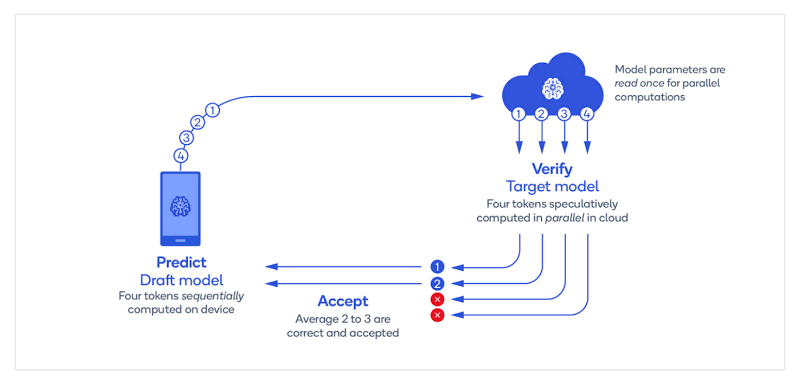
Almost certainly not. The likely future is two brains working together: a local one that’s fast, private, available offline and easy on the battery — ideal for everyday writing, searching and tidying — and a cloud one that’s far more capable, better suited to genuine research, long documents, and serious coding work. Your phone’s software will simply decide which one a given task needs, mostly without you noticing the handover at all.
Where Phone-Based AI Still Falls Short
Running AI locally isn’t free of trade-offs. A small model can happily polish an email but will struggle with a genuinely complex logic problem or deep academic research — it just doesn’t have the scale for that. Heavy local processing draws real power too, so leaning on it constantly can warm the phone up and drain the battery faster than you’d like. Even a heavily compressed model still takes up real storage space, and — this one catches people out — an offline model only knows what it learned during training. It has no way of telling you today’s football scores, breaking news, or the current weather without an actual internet connection.
Why This Also Makes Financial Sense for Tech Companies
Running AI in the cloud isn’t just about servers humming away somewhere — every single prompt costs real electricity, wears down real hardware, and eats real bandwidth. Multiply that by millions of people asking quick questions all day, and the bill for the company on the other end gets genuinely enormous. Shift routine, everyday tasks onto the phone’s own hardware instead, and companies cut a serious chunk of that server cost while handing you something faster and more private in the process. It’s a rare case where the cheaper option for the company and the better option for you happen to line up.
Frequently Asked Questions
Can AI really run completely offline on a smartphone?
Yes. Modern mobile operating systems now build compact language models directly into the software, and tasks like summarising text, transcribing audio, and translating on the fly can all run with no internet connection at all.
Is on-device AI actually more private than cloud AI?
In almost every case, yes. If a task is processed locally, your text, images and personal data simply never leave your handset — there’s nothing for a third party to store or inspect, because it was never sent anywhere.
Will tiny AI models drain my battery?
They use some power, but because they’re built to run on dedicated hardware like an NPU, short everyday tasks — rewriting a sentence, summarising a note — use surprisingly little.
Do I need a brand-new phone for this?
To run the current generation of on-device models, you generally need a reasonably recent handset with a dedicated neural processor and enough memory to hold the model.
The Future of AI Is in Your Pocket
The next real leap in AI isn’t only happening in vast data centres out in the desert. Just as much of it is happening in the effort to make AI small, fast and efficient enough to fit in your pocket. Before long, you probably won’t open a separate chatbot app every time you need a hand with something. It’ll simply be built into your keyboard, your camera roll, your notes app and your operating system — working quietly in the background, whether you’re online, offline, or three floors into a warehouse with no signal at all.