
For a few nights in May 2024, social media filled up with photos of pink and green skies from places that have no business seeing the aurora — well south of where anyone expects to catch the northern lights. It made for a genuinely beautiful few days online. It was also, less romantically, a live demonstration of GPS-guided tractors losing their bearings mid-planting season and costing American farmers an estimated half a billion dollars. The same event, two completely different stories.
The Sun looks perfectly calm from 150 million kilometres away. In reality, it’s an enormous ball of electrically charged gas wrapped in a magnetic field that’s constantly twisting, snapping and rearranging itself. Every so often, that activity produces what could jokingly be called a solar burp: an eruption that throws radiation, particles and magnetic field out into space. Aim one of those at Earth, and you get a solar storm capable of disturbing GPS navigation, radio communications, satellites, and occasionally electrical power grids themselves.
Most solar storms pass by without incident. The extreme ones matter because modern life leans on technology that turns out to be surprisingly sensitive to changes in the space environment above our heads. So how does something happening on the surface of the Sun end up interfering with your phone’s GPS, or potentially cutting power on the ground?
What Actually Is a Solar Storm?

“Solar storm” covers a few related phenomena rather than one single thing.
Solar flares are enormous bursts of electromagnetic radiation, released when magnetic energy in the Sun’s atmosphere suddenly rearranges itself. Because that radiation travels at the speed of light, it reaches Earth in roughly eight minutes, and a powerful flare can disturb the ionosphere — the electrically charged layer of our upper atmosphere — enough to interfere with high-frequency radio and satellite-navigation signals.
Coronal mass ejections, or CMEs, are a different beast entirely. Rather than radiation, a CME launches an enormous cloud of plasma (extremely hot matter stripped down into electrically charged particles) and magnetic field out into space. CMEs travel far slower than light — an Earth-directed one typically takes somewhere between one and four days to arrive, which is exactly the window space-weather forecasters use to issue warnings before it actually hits.
What Happens When a Solar Storm Reaches Earth?
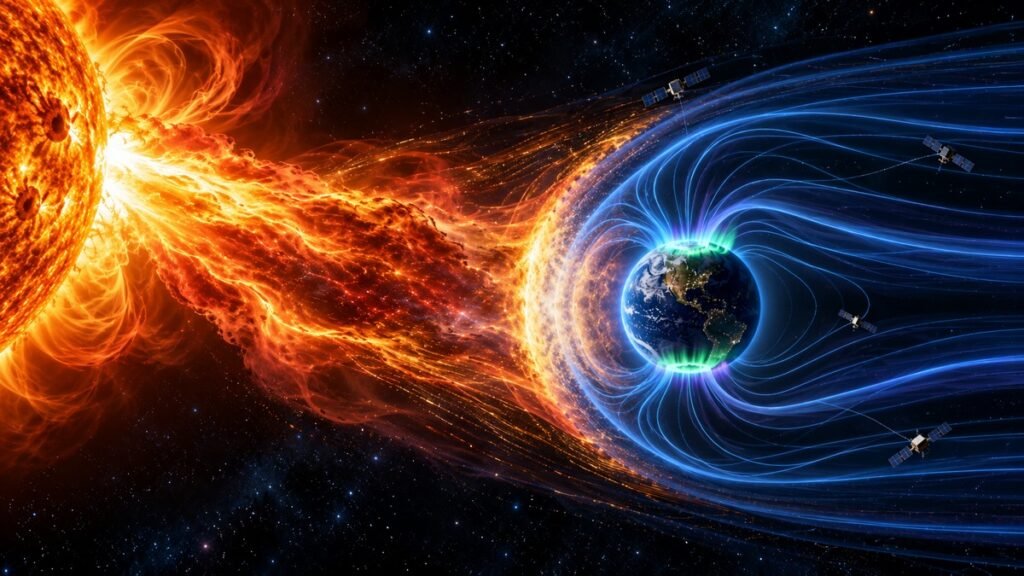
Fortunately, Earth isn’t defenceless. A magnetic field surrounds the planet, forming a protective bubble called the magnetosphere. When a CME arrives, its own magnetic field can interact with that bubble, and under the right conditions, a large amount of energy transfers into Earth’s magnetic environment. The result is a geomagnetic storm.
The same process responsible for one of nature’s most spectacular sights — the aurora borealis and aurora australis — can simultaneously cause considerably less photogenic problems for technology: electrical currents entering power networks, reduced GPS and satellite-navigation accuracy, disrupted high-frequency radio, satellite electronics glitches, extra atmospheric drag on low-orbit satellites, and increased radiation exposure for astronauts and some high-altitude flights. NOAA classifies geomagnetic storms on a scale from G1 (minor) up to G5 (extreme).
How Can a Solar Storm Actually Knock Out a Power Grid?
This is the effect that still sounds faintly unbelievable. A solar storm doesn’t send electricity directly from the Sun into anyone’s wall socket. What it does is rapidly change Earth’s magnetic field — and under Faraday’s law of electromagnetic induction, a changing magnetic field induces an electrical current inside any nearby conductor. Modern civilisation happens to be criss-crossed with extraordinarily long conductors: power transmission lines, railway tracks, and pipelines that stretch for hundreds or thousands of kilometres.
During a major geomagnetic storm, that changing field can therefore generate what engineers call geomagnetically induced currents, or GICs, inside these systems. Electrical grids are engineered to operate within fairly tight voltage and current ranges, and an unexpected current flowing through the network can push large transformers outside those ranges — overheating them, tripping protection systems, destabilising voltage, and disconnecting whole sections of the grid. In a worst case, those failures can cascade across an entire network.
That’s not a hypothetical scenario. It’s already happened.
The 1989 Québec Blackout: When the Sun Turned Off the Lights
On 13 March 1989, a powerful geomagnetic storm struck Earth, and Hydro-Québec’s power network began experiencing severe electrical disturbances. At 2:44 a.m., protection systems started tripping — and the entire grid collapsed in roughly 90 seconds, leaving the province without power for more than nine hours in the depths of a Canadian winter.
It remains one of the clearest real-world demonstrations that activity on the Sun can directly affect major infrastructure on the ground. Power companies took the lesson seriously: Hydro-Québec subsequently changed its protection settings and introduced real-time monitoring for geomagnetic disturbances, and modern grid operators generally now track space weather and can reconfigure their networks when severe conditions are forecast, rather than simply waiting to find out what happens.
How Solar Storms Disrupt GPS
GPS has its own particular vulnerability: the signal has to pass through Earth’s atmosphere to reach you. GPS satellites broadcast extremely precise radio signals, and receivers calculate position largely from how long those signals take to arrive. That works remarkably well under normal conditions — but the signal passes through the ionosphere, a layer of charged particles in the upper atmosphere, and a solar storm can dramatically change how dense and evenly distributed those particles are. The result is a signal that gets delayed, distorted, or rapidly fluctuates, an effect called scintillation.
For an ordinary phone doing road navigation, that usually just means reduced accuracy — mildly annoying at worst. For the centimetre-level positioning used in agriculture, construction, surveying and drilling, the consequences run considerably deeper. NOAA notes that severe space weather can degrade GPS measurements, or in extreme cases cause a receiver to lose signal lock entirely.
The 2024 Storm Showed Exactly Why GPS Matters

In May 2024, Earth experienced its first G5 “extreme” geomagnetic storm in more than two decades — the event behind those unusually widespread aurora photos, now generally referred to as the Gannon storm. It also happened to land squarely in the middle of the US planting season, and modern tractors rely on high-precision GPS to drive extremely exact rows while sowing crops. GPS errors during the storm reportedly threw some receivers off by hundreds of feet, in parts of the country for a day or more. Terry Griffin, an agricultural economist at Kansas State University, later estimated the resulting hit to American farmers’ potential profit at around $500 million, with some follow-up analysis putting the figure closer to $565 million.
GPS, in other words, stopped being just the thing that tells drivers where to turn some time ago. It now quietly underpins farming, aviation, shipping, telecommunications, financial networks, and the precise timing signals a lot of infrastructure depends on without most people ever noticing.
Solar Storms Can Take Out Satellites, Too
Satellites face a problem that sounds almost backwards: during a geomagnetic storm, space effectively gets “thicker.” Energy dumped into the upper atmosphere heats it, the atmosphere expands upward, and the thin gases surrounding low-orbit satellites become measurably denser — producing extra atmospheric drag.
In February 2022, SpaceX launched 49 new Starlink satellites into low Earth orbit just as a geomagnetic storm heated and expanded the upper atmosphere. The resulting drag was enough that 38 of the 49 satellites re-entered the atmosphere and burned up within days, rather than settling into their intended orbits. It was a striking demonstration that even a fairly moderate space-weather event can carry a genuinely expensive price tag — SpaceX later put the loss at tens of millions of dollars.
Could an Extreme Solar Storm Cause a Global Blackout?
A severe storm could certainly cause serious regional disruption, but the idea that one eruption would automatically take down every grid on Earth simultaneously doesn’t really hold up. Risk depends on a long list of factors: the storm’s strength and magnetic orientation, geographic location, how long the local transmission lines run, the geology underneath them, transformer design, overall grid configuration, and the protective systems a given operator has in place.
Higher-latitude regions tend to be more exposed, since geomagnetic disturbances generally strengthen closer to the magnetic poles, and utilities typically receive warning before a major CME arrives, giving operators time to step up monitoring or take protective action. A G5 storm can absolutely cause serious grid problems — it doesn’t automatically mean widespread blackouts. NOAA’s scale describes potential impact, not a guaranteed outcome.
What Was the Carrington Event?
The usual worst-case historical reference point is 1859. British astronomer Richard Carrington observed an enormous solar flare shortly before an exceptionally powerful geomagnetic storm struck Earth, and the Carrington Event is generally considered the strongest geomagnetic storm in recorded history.
At the time, there were no satellites, no GPS, no mobile networks, and no continent-spanning electrical grids to worry about — the telegraph was about as far as long-distance electrical technology stretched. A comparable event today would land very differently, simply because modern economies run on vastly more electrically connected infrastructure than existed in 1859. That doesn’t mean civilisation would collapse. It means operators today would have a great deal more to protect than their Victorian counterparts ever did.
Can Scientists Actually Predict Solar Storms?
Not in the way a weather forecaster predicts rain next Tuesday — individual solar eruptions can’t be called weeks in advance. Once an Earth-directed CME has actually erupted, though, satellites and observatories can track it, and forecasters can estimate whether it’s heading for Earth, how fast it’s travelling, roughly when it will arrive, and how severe the resulting geomagnetic storm might turn out to be.
There’s still real uncertainty baked in, mainly because the CME’s magnetic field orientation matters enormously — a CME with an orientation that interacts strongly with Earth’s own field can produce a far bigger disturbance than another CME travelling at a similar speed with the “wrong” orientation. That’s why forecasts keep getting revised as new measurements come in, right up until arrival.
Keeping an Eye on Space Weather Yourself
You don’t need any specialist equipment to follow space weather — a handful of reputable, free services publish forecasts, alerts and live measurements. SpaceWeatherLive offers live solar activity, CME tracking and geomagnetic data; NASA publishes excellent plain-language explanations alongside satellite imagery; and NOAA’s Space Weather Prediction Center is the official source for watches, warnings and the G1–G5 storm scale, monitoring conditions continuously and issuing alerts covering geomagnetic storms, radiation storms and radio blackouts. Plenty of national meteorological and space agencies around the world run their own regional alert services too, often including an aurora outlook, so it’s worth checking what your own country’s weather or space agency publishes.
Should Ordinary People Actually Prepare for This?

For most people, solar storms aren’t something worth losing sleep over. Earth’s atmosphere and magnetic field shield the surface from the vast majority of dangerous solar radiation — the realistic everyday risk is disruption to technology, not direct physical harm. Basic blackout preparedness is sensible regardless of the cause, whether that’s space weather, an ordinary storm, or a simple equipment fault: a decent power bank (10,000–20,000 mAh covers most needs), a rechargeable torch, a surge protector, and a battery-powered radio will cover most scenarios. A small uninterruptible power supply can also keep something like a broadband router running through a brief interruption. There’s little reason for an average household to buy anything specifically marketed for solar storms — following official warnings when they’re issued is considerably more useful than stockpiling specialist kit.
Frequently Asked Questions
Can a solar storm knock out the internet? Potentially, but a complete worldwide shutdown is extremely unlikely. Solar storms can interfere with satellites, electrical grids and some communications infrastructure, so local or regional outages could occur indirectly if the power or telecoms systems supporting the internet were disrupted.
Can solar storms damage smartphones? Direct damage to a phone on the ground is unlikely — Earth’s atmosphere provides substantial protection. GPS accuracy, mobile infrastructure, or the electricity supply powering nearby equipment could still be affected during a severe event, though.
How long does a solar storm take to reach Earth? Radiation from a solar flare arrives in about eight minutes. A coronal mass ejection is far slower, generally taking one to four days, though exceptionally fast ones can arrive sooner.
Can solar storms cause GPS to stop working entirely? Yes, in severe cases. Ionospheric disturbances can reduce GPS accuracy and, under the right conditions, cause a receiver to temporarily lose lock on satellite signals altogether. Precision GPS systems tend to be considerably more vulnerable than ordinary consumer navigation.
Are solar storms dangerous to humans? Generally not for anyone on the ground — the atmosphere and magnetic field provide substantial shielding. Astronauts, and people travelling at very high altitude or over polar regions, face somewhat greater radiation exposure during powerful events.
The Sun Is Part of Our Technological Environment Now
A solar storm is a useful reminder that modern technology doesn’t exist in a bubble, separate from nature. The same star quietly powering nearly every ecosystem on Earth can, every so often, fling an enormous burst of radiation, plasma and magnetic energy directly at us. Most of the time, that produces little more than a spectacular light show. Occasionally, it disrupts GPS, disturbs radio communications, drags satellites out of orbit, and pushes power grids into genuinely dangerous operating territory.
The 1989 Québec blackout, the Starlink losses of 2022, and the GPS disruption during the 2024 Gannon storm all show this is a real, recurring risk rather than science fiction. The encouraging part is that scientists can now watch the Sun continuously, track incoming CMEs as they happen, and give infrastructure operators genuinely useful advance warning. So next time an unusually bright aurora shows up somewhere it has no business being, it’s worth remembering: those colours are the visible edge of a much bigger interaction playing out between the Sun, Earth’s magnetic field, and the technology the modern world quietly depends on.