

Have you ever walked into a fishmonger, caught a massive wave of that fishy aroma, and wondered, “How on earth do the staff survive working in here all day?”
Or maybe you’ve sprayed on a high-end cologne, received compliments from people later in the day, but thought to yourself, “I literally can’t smell it at all.” The same thing happens with your own home. You don’t notice its unique scent until you leave for a few days and step back through the front door. Suddenly, the smell is completely obvious.
The reason behind this disappearing act is a biological phenomenon called olfactory adaptation—more commonly known as “nose blindness.” Essentially, your brain is actively filtering out the background noise.
But how does this happen, and why is your mind hardwired to tune you out? Let’s break down the science simply.
Key Takeaway: You cannot smell yourself due to a biological process called olfactory adaptation. Your nervous system is hardwired to ignore constant, unchanging stimuli to prevent sensory overload and save metabolic energy. By filtering out your own predictable scent, your brain keeps its radar clear to detect new, critical smells in your environment.
Sensory Adaptation: The Ultimate Background Filter
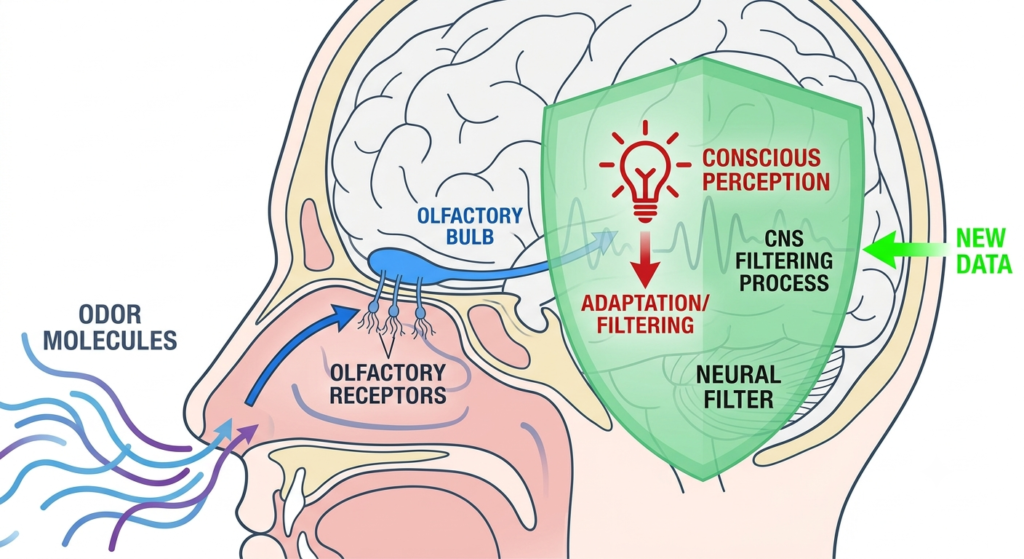
Your nervous system is designed to detect changes in your surroundings and environment, not constants.
Think of it like walking into your local shop. If they install a brand-new, bright display fridge, you will notice it immediately. But by your next visit? It’s no longer a new “event” to your brain—it just blends into the background.
The exact same rule applies to your sense of smell. When your olfactory receptors are constantly exposed to the same odor molecules—like your natural body odor, your favorite cologne, or your laundry detergent—your body adapts. The receptor cells literally stop sending signals to your brain about that specific, unchanging scent.
That doesn’t mean it’s impossible to check in on your own hygiene. You can still sniff your underarm for a quick reality check! But under normal circumstances, your brain prefers to keep that channel muted.
In fact, smell isn’t the only sense where your brain plays this trick. It is the exact same reason you don’t constantly feel the clothes touching your skin, or consciously hear the steady hum of your refrigerator. Your brain simply files it under “information I already know.”
Why Does the Brain Act Like That?
Good news: your brain isn’t doing this out of laziness. It is actually a highly strategic move driven by evolutionary survival and energy efficiency.
If your brain tried to process every single piece of sensory data hitting it at any given second, you would suffer from immediate sensory overload. Here is why your brain acts as a strict gatekeeper:
1. Threat Detection
From an evolutionary standpoint, constant stimuli represent safety. (Quick definition: stimuli are simply changes in the environment that cause a reaction or a response in a living organism).
Imagine a primitive human sitting in a cave. The familiar smell of their own body or the cave dirt is completely irrelevant to their survival. However, the sudden, faint scent of a nearby predator, a distant wildfire, or rotting meat is life-or-death information. By tuning out the safe, predictable background noise, the brain keeps its radar completely clear for new hazards.
2. Energy Preservation
Your brain is an absolute energy hog. It makes up only about 2% of your body weight, but it consumes roughly 20% of your body’s total energy.
Sending continuous electrical signals from your nose to your brain requires a lot of metabolic fuel. To conserve power, your nervous system uses a shortcut: if a stimulus isn’t changing, the receptor cells slow down or stop firing entirely. Your brain figures, “Nothing new is happening here, let’s shut down this pathway to save electricity.”
3. Habituation and Focus
Imagine trying to read a book, but your conscious mind is forced to focus on the physical pressure of your socks, the sound of your own breathing, the visual presence of your nose, and the aroma of your laundry detergent. You wouldn’t be able to focus on a single sentence. Sensory filtering allows you to focus on complex tasks without getting bogged down by the baseline mechanics of existing.
Why Do Other People Smell You Before You Do?
If your brain mutes your own scent, why can a friend or coworker notice your perfume or body odor instantly?
It comes down to a simple rule: your scent is a constant to you, but a sudden change to them.
You live inside a personal “scent cloud” generated by your body heat and clothing. Because you move with this cloud, your nasal receptors have long since tuned it out. But when someone else walks into your space, they are stepping into that cloud for the first time.
Their olfactory receptors are completely fresh. Because your scent represents a sudden, sharp spike in environmental data, their brain flags it immediately and pushes it straight to their conscious awareness. To you, you are background static; to them, you are brand new data.
How to “Reset” Your Nose
Because your brain tracks changes, the easiest way to break nose blindness is to change your environment or spike the intensity of the smell.

- The Vacation Effect: When you go away for a week and step back into your home, the sudden shift in your environment makes your “house smell” instantly noticeable for the first few minutes.
- The Workout Effect: If you go for a run, your body heat and sweat create a brand new, much stronger concentration of scent molecules. Because the intensity just spiked, your brain registers the change, and suddenly you can smell yourself.
If you ever want to quickly reset your nose to check your own scent on the spot, perfumers recommend smelling something completely neutral and different. You can sniff clean, unperfumed bare skin (like the crook of your elbow) or take a whiff of coffee beans to clear the palate!
Conclusion
At the end of the day, you can’t smell yourself because your brain treats your own scent as the baseline of safety. It prioritises relevance over accuracy. It doesn’t care about giving you a perfect, objective breakdown of how you smell at every moment; it only cares about keeping you safe, saving energy, and ensuring you can focus on the world around you. So the next time you can’t smell your own cologne, thank your brain for working exactly the way it’s supposed to.
FAQ
What is olfactory adaptation?
Olfactory adaptation, commonly known as nose blindness, is a temporary, normal inability to distinguish a particular odour after a prolonged period of exposure to it. It occurs when your nasal receptors stop sending signal alerts to the brain about a constant, unchanging scent.
Why can other people smell my perfume when I can’t?
Because your personal scent cloud moves with you, it is a constant stimulus that your brain filters out. However, to another person entering your personal space, your scent represents a sudden change in their environment. Their fresh olfactory receptors pick up the novel molecules instantly.
Does nose blindness mean my sense of smell is damaged?
Not at all. Nose blindness is a healthy, natural function of the central nervous system designed to prevent sensory overload and preserve brain energy.
How long does it take to get nose blind to a smell?
It can happen surprisingly fast. Depending on the strength of the odor, your olfactory receptors can begin desensitising and fading a constant smell into the background within just a few minutes of continuous exposure.