
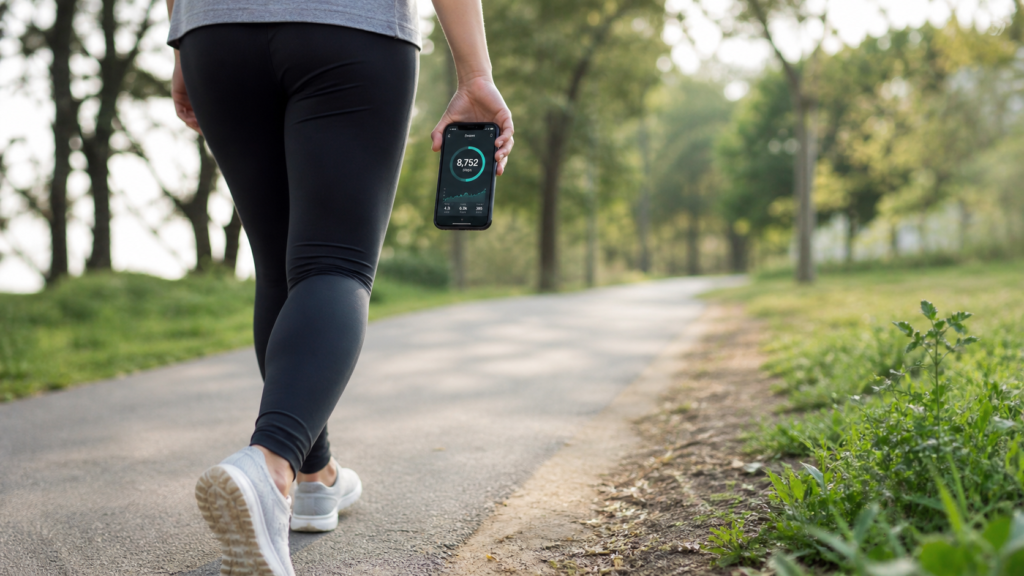
Walking is one of the simplest ways to improve your health. You do not need a gym, expensive equipment, or a perfect routine. You only need comfortable shoes, a safe route, and a realistic plan you can repeat.
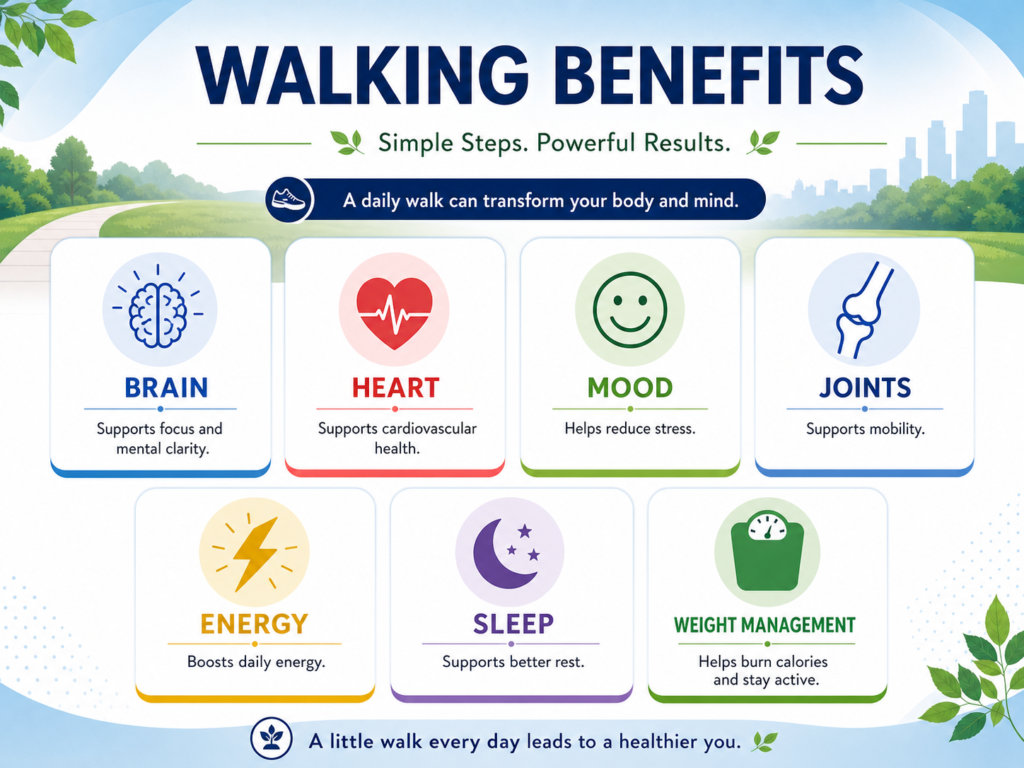
The benefits of walking daily go far beyond burning calories. Regular walking can support your brain, heart, mood, joints, sleep, energy, and long-term wellbeing.
Even better, you do not have to walk for hours. A brisk 10-minute daily walk can support health and count towards weekly physical activity goals, while 20–30 minutes most days can create a strong foundation for better fitness. The NHS says brisk walking can help build stamina, burn calories, and make your heart healthier. (nhs.uk)
What Counts as Walking for Health?
Walking for health means walking regularly at a pace that gently raises your heart rate, warms your body, and makes you breathe slightly faster while still being able to talk.
This is often called brisk walking. It is not a sprint. It is simply more purposeful than a slow stroll.
Examples include:
- Walking to work or school
- Walking during lunch breaks
- Walking after dinner
- Walking around a park
- Walking on a treadmill
- Walking while listening to a podcast
- Getting off public transport one stop earlier
For most adults, health guidelines recommend around 150 minutes of moderate-intensity activity per week, which can include brisk walking. The CDC and NHS both describe 150 minutes weekly as a key adult physical activity target. (CDC)
Why Walking Daily Works So Well
Walking works because it is low-cost, low-barrier, and easy to repeat.
Many fitness plans fail because they require too much change too quickly. Walking fits into normal life. You can start with 10 minutes per day, then build to 20–45 minutes as your fitness improves.
The biggest advantage is consistency. A 20-minute walk 5 days per week gives you 100 minutes of movement. A 30-minute walk 5 days per week reaches the 150-minute weekly target.
1. Walking Supports Brain Health
Walking increases blood flow, encourages movement, and supports the systems linked to memory, thinking, and mood.
Exercise may support memory and thinking both directly and indirectly. Harvard Health notes that exercise can improve memory and thinking by improving mood and sleep while reducing stress and anxiety, which can contribute to cognitive problems. (Harvard Health)
A simple example:
If you feel mentally stuck after 3–4 hours at a desk, take a 10-minute walk outside or around your building. The movement, light, and change of environment can help reset your attention before returning to work.
2. Walking Can Improve Mood and Reduce Stress
Walking can help calm the nervous system, especially when you combine it with fresh air, daylight, and steady breathing.
You do not need an intense workout to feel a difference. A short walk can give your brain a break from screens, notifications, and repeated thoughts.
Try this simple stress-reset walk:
- Walk for 10–15 minutes
- Keep your phone in your pocket
- Breathe slowly through your nose if comfortable
- Notice 5 things you can see
- Walk at a pace that feels easy but purposeful
The World Health Organization says regular physical activity provides mental health benefits and can reduce symptoms of depression and anxiety while improving brain health and overall wellbeing. (World Health Organization)
3. Walking Helps Your Heart and Circulation
Walking is a form of cardiovascular exercise, which means it works your heart, lungs, and blood vessels.
A regular walking habit can help improve cardiovascular fitness, support blood pressure, and reduce health risks over time. Mayo Clinic lists walking benefits including improved cardiovascular fitness, stronger bones and muscles, better energy, improved mood, memory and sleep, and support for weight management. (Mayo Clinic)
Practical scenario:
If you currently walk fewer than 3,000–4,000 steps per day, start by adding 1,000 extra steps daily. That could be a 10-minute walk after lunch or dinner. After 2 weeks, add another 1,000 steps if it feels manageable.
4. Walking Supports Healthy Weight Management
Walking helps you burn calories, but its real strength is sustainability.
A very intense workout may burn more calories in one session, but walking is easier to repeat daily. That makes it useful for long-term weight management.
Mayo Clinic explains that adding 30 minutes of brisk walking to your daily routine could burn about 150 extra calories per day, though the exact amount depends on pace, distance, and body weight. (Mayo Clinic)
Example:
If you walk briskly for 30 minutes 5 days per week, that may burn around 750 extra calories weekly. Combined with balanced meals and fewer sugary drinks or snacks, walking can support gradual fat loss without extreme dieting.
5. Walking Strengthens Muscles, Joints, and Bones
Walking is weight-bearing exercise, which means your body works against gravity. This can support bones, muscles, balance, and everyday mobility.
It is especially useful because it is gentle compared with high-impact exercise. Most beginners can start walking without needing advanced technique.
Walking may help:
- Strengthen leg muscles
- Support joint movement
- Improve balance and coordination
- Maintain bone and muscle function
- Make stairs and daily tasks easier
If you feel stiff from sitting, try a 5-minute walk every 60–90 minutes. These short movement breaks can reduce sedentary time and help your body feel less locked up.
6. Walking Can Improve Energy Levels
It may sound strange, but walking can help you feel more energised, not more tired.
Light-to-moderate movement increases circulation and helps break the cycle of sitting, scrolling, and low energy. It is especially useful during the afternoon slump.
Try this:
- Drink a glass of water
- Walk for 10 minutes
- Get daylight if possible
- Return to your task for 25 minutes
This simple routine can work better than reaching for another coffee every time your energy drops.
7. Walking May Improve Sleep Quality
Walking can support sleep by helping regulate stress, energy use, mood, and daily rhythm.
Morning or daytime walks may be especially useful because natural light helps reinforce your body clock. Evening walks can also help if they are calm and not too intense.
A practical plan:
- Morning: 10 minutes outdoors after waking
- Lunch: 10 minutes after eating
- Evening: 10–15 minutes after dinner
This gives you 30–35 minutes of walking without needing one long workout.
8. Walking Helps Reduce Sedentary Time
Sitting for long periods is common, especially if you work at a desk, drive often, study, or spend evenings on screens.
Walking gives you an easy way to interrupt long sitting blocks.
Use the 60-minute rule:
After every 60 minutes of sitting, stand up and walk for 3–5 minutes. This could be around your room, office, warehouse, garden, or street.
By the end of a workday, five short walks can add 15–25 minutes of movement without feeling like formal exercise.
9. Walking Can Make Healthy Habits Easier
Daily walking often improves other habits because it gives your day structure.
For example:
- A morning walk can reduce phone scrolling
- A lunch walk can prevent afternoon sluggishness
- An evening walk can replace snacking from boredom
- A weekend walk can become low-cost social time
- A walking routine can support hydration and sleep
This is why walking is powerful. It is not just exercise. It is a keystone habit that can make several other habits easier.
10. Walking Is Affordable and Easy to Start
Walking is one of the most accessible health habits because the cost can be very low.
You may only need:
- Comfortable trainers: $40–$120
- Basic socks: $5–$20
- Reusable water bottle: $10–$30
- Step tracking app: $0–$10 per month
- Weather-appropriate clothing: $20–$100
You do not need to buy everything at once. Start with what you already own, then upgrade shoes or clothing if walking becomes part of your routine.
Best Walking Apps and Tools
Walking tools can help you track progress, stay motivated, and build consistency. Keep the system simple. One app and one goal are enough.
Global
- Google Fit — simple step and activity tracking
- Apple Health — built-in iPhone walking data
- Strava — route tracking and social motivation
United States
- MapMyWalk — route tracking and pace data
- Fitbit — step goals and wearable tracking
- Nike Run Club — guided walks and runs
United Kingdom / Europe
- NHS Active 10 — tracks brisk 10-minute walks
- Komoot — route planning for outdoor walks
- AllTrails — walking and hiking route discovery
Advanced users
- Garmin Connect — detailed walking and fitness data
- TrainingPeaks — structured endurance progress tracking
- Runkeeper — pace, distance, and training history
Use tools to support the habit, not complicate it. If checking the app feels harder than walking, simplify.
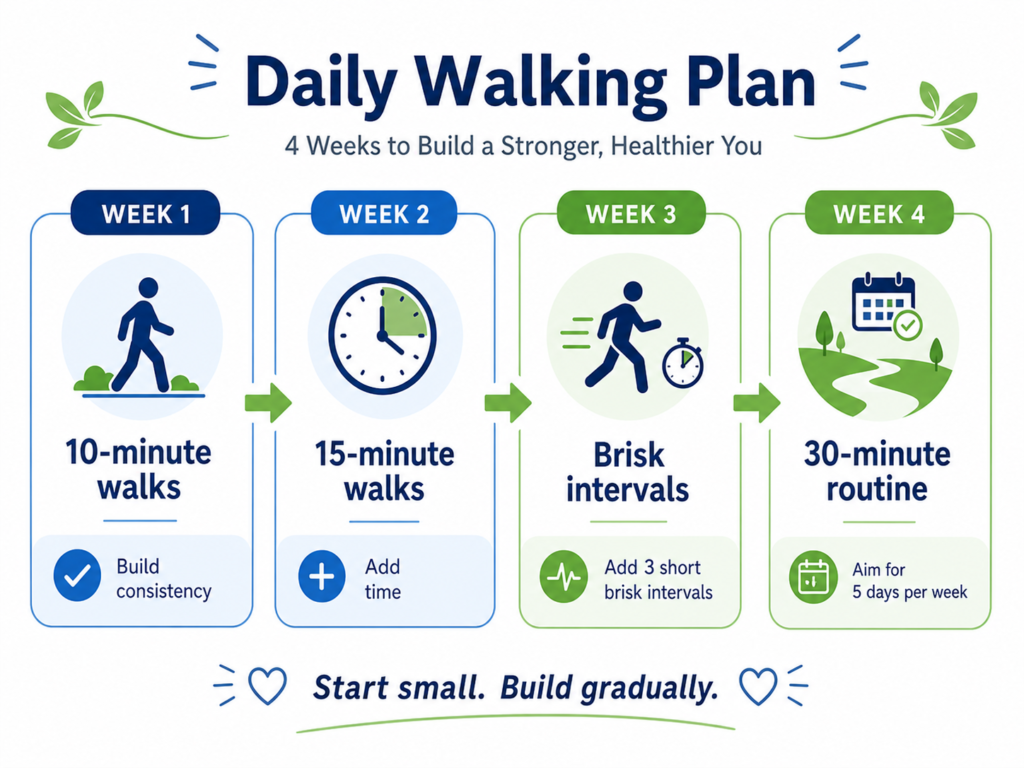
How to Start a Daily Walking Habit
Start smaller than you think you need.
Week 1: Build consistency
Walk 10 minutes per day, 5 days this week. Keep the pace comfortable.
Week 2: Add time
Increase to 15–20 minutes, 5 days per week.
Week 3: Add brisk sections
During your walk, add 3 short brisk intervals of 1–2 minutes each.
Week 4: Aim for the weekly target
Work towards 30 minutes per day, 5 days per week, which equals 150 minutes.
This gradual plan reduces soreness, builds confidence, and makes the habit easier to keep.
Safety Tips for Daily Walking
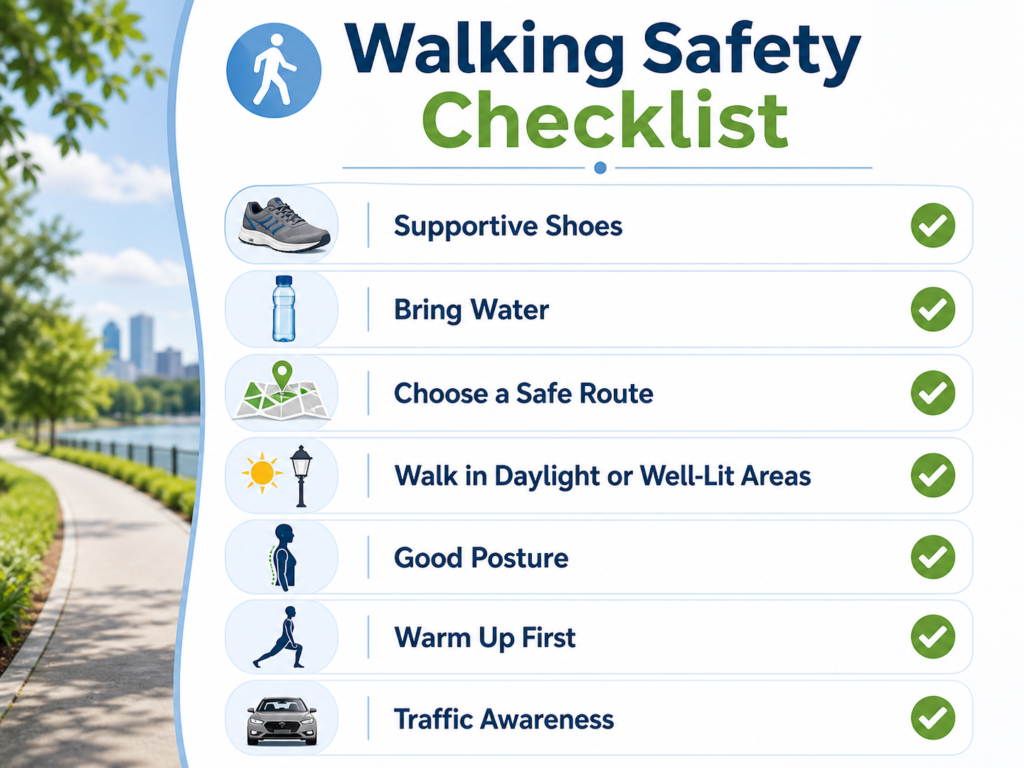
Walking is safe for most people, but smart preparation matters.
Use these tips:
- Wear supportive shoes
- Start slowly if you are inactive
- Walk in well-lit areas
- Carry water for longer walks
- Use sunscreen in strong sun
- Avoid headphones too loud near roads
- Choose safer routes when walking alone
- Speak to a healthcare professional if you have chest pain, severe breathlessness, dizziness, or a medical condition that affects exercise
If you are new to activity, start with 5–10 minutes and build gradually.
FAQ
What are the main benefits of walking daily?
The main walking benefits include better cardiovascular fitness, improved mood, reduced stress, stronger muscles and joints, better energy, weight management support, and improved brain health. The benefits are strongest when walking becomes consistent.
Is 10 minutes of walking a day enough?
A brisk 10-minute walk is a useful starting point and can support health. For broader fitness benefits, build towards 150 minutes of moderate activity per week, such as 30 minutes of brisk walking 5 days per week. (nhs.uk)
How many steps should I walk daily?
There is no perfect step count for everyone. If you are inactive, start by adding 1,000–2,000 steps per day. Many people use 7,000–10,000 steps as a long-term target, but consistency matters more than a perfect number.
Is walking better in the morning or evening?
Both can work. Morning walks may support energy and body clock rhythm, while evening walks can reduce stress and help digestion after dinner. The best time is the time you can repeat most days.
Can walking help with weight loss?
Yes, walking can support weight loss by increasing daily calorie burn and reducing sedentary time. It works best when combined with balanced meals, enough sleep, hydration, and consistent habits.
Conclusion
Walking daily improves your brain and body because it is simple, repeatable, and effective. It supports your heart, mood, energy, sleep, joints, weight management, and long-term health without requiring expensive equipment or a complicated routine.
Start with 10 minutes per day, then build towards 30 minutes 5 days per week. Use a step tracker if it helps, but do not make the system too complex.
The best walk is the one you actually take.
CTA: Take a 10-minute walk today, then schedule your next four walks for this week. Small steps repeated daily can create a stronger body and a clearer mind.