

I
nvesting can feel exciting, confusing, and risky when you are starting out. One video says buy stocks now, another says wait, and a third tells you the “best” investment is something you barely understand.
The truth is simpler: most beginner investing mistakes come from rushing, guessing, copying others, or investing without a clear plan.
This guide explains the top 10 beginner-friendly investing mistakes to avoid. You will learn how to think about risk, diversification, fees, platforms, time horizon, and emotional decisions in a simple, practical way.
This article is for education only, not personal financial advice. Investments can rise and fall in value, and you could get back less than you put in.
What Are Investing Mistakes?
Investing mistakes are decisions that increase your risk, reduce your returns, or make it harder to stay consistent over time.
Common examples include investing money you need soon, buying only one stock, following hype, ignoring fees, panic-selling, or choosing products you do not understand.
Good investing is not about being perfect. It is about avoiding avoidable mistakes and building a system you can stick with for years.
Why Beginners Make Investing Mistakes
Beginners often make mistakes because investing mixes money, emotion, uncertainty, and long timeframes.
You may feel pressure to start fast, fear missing out, or panic when prices fall. You may also hear confident opinions from friends, influencers, or online communities.
A better approach is to slow down and ask:
- What is my goal?
- When do I need the money?
- How much risk can I handle?
- What fees am I paying?
- Do I understand this investment?
- Is my portfolio diversified?
FINRA explains that suitable investment strategies vary depending on factors such as income, assets, age, risk tolerance, obligations, and lifestyle. (FINRA)
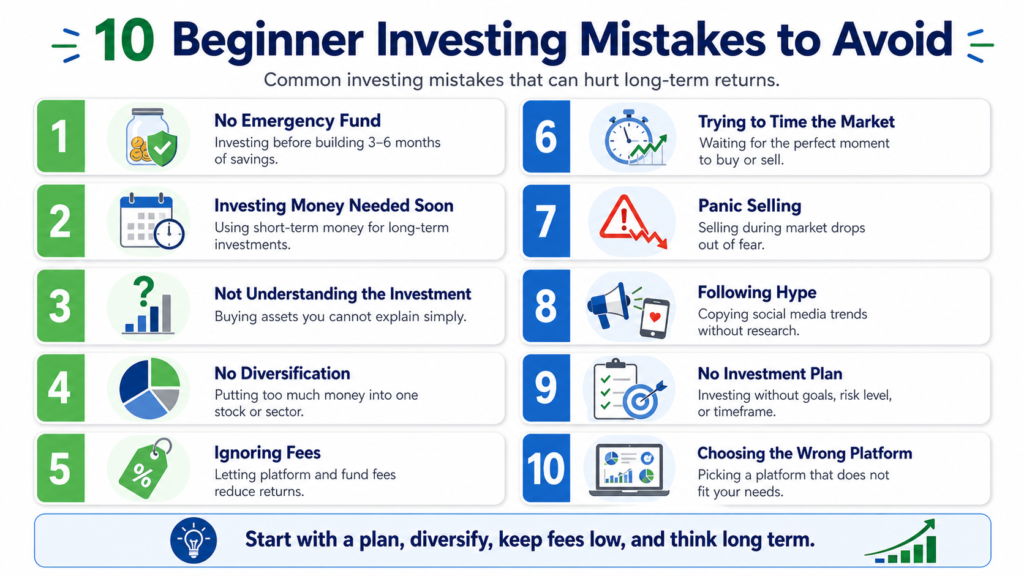
1. Investing Without an Emergency Fund
One of the biggest beginner investing mistakes is investing before you have basic financial safety.
Investing is for money you can leave alone. If you might need the money for rent, bills, repairs, or job loss, it should usually stay in safer short-term savings.
A practical starting point is to build an emergency fund of 3–6 months of essential expenses before investing aggressively. If your essential costs are $2,000 per month, aim for $6,000–$12,000 in accessible savings.
Simple example:
- Emergency fund: $6,000–$12,000
- Monthly investing: $50–$300 after bills and savings
- High-interest debt: paid down before taking extra risk
This gives you breathing room, so you are less likely to sell investments during a bad month.
2. Investing Money You Need Soon
Investing short-term money can be dangerous because markets can fall when you need to withdraw.
If you need money within 1–3 years, such as for a house deposit, tuition, wedding, car, or relocation, taking high investment risk may not be suitable.
FINRA explains that asset allocation depends on risk tolerance and investment horizon. For example, money needed soon may be held more heavily in cash or cash equivalents, while long-term retirement money may hold more stocks. (FINRA)
A simple rule:
- Need money in 0–3 years: focus on safer cash savings
- Need money in 3–7 years: use moderate caution
- Need money in 7+ years: investing may be more suitable
Your timeframe matters as much as your return goal.
3. Buying Investments You Do Not Understand
Never invest because something sounds exciting, complicated, or popular.
Before buying any investment, you should understand:
- What it is
- How it makes money
- What can go wrong
- What fees apply
- How long you may need to hold it
- Whether it fits your goal
Example:
A beginner might buy a single tech stock because it is popular online. But if that company falls 30–50%, they may panic because they never understood the business, valuation, or risk.
A safer learning approach is to start with broad, simple investments, such as diversified index funds or ETFs, then learn more before buying individual shares.
4. Putting Too Much Money Into One Stock
Putting most of your money into one stock is risky, even if the company is famous.
This is called concentration risk. If that one company performs badly, your whole portfolio can suffer.
Diversification means spreading your money across different investments, sectors, countries, and asset types. The FCA explains diversification as spreading investments across products and markets so you are not dependent on one thing performing well. (FCA)
Example:
Instead of putting $1,000 into one company, a beginner might put $800 into a broad global fund and $200 into individual stocks they want to learn from. That still allows learning, but reduces the risk of one decision damaging the whole portfolio.
5. Ignoring Fees
Fees can quietly reduce your investment returns.
Common fees include:
- Platform fees
- Fund management fees
- Trading fees
- Currency conversion fees
- Withdrawal fees
- Advice or managed portfolio fees
A fee that looks small can matter over decades. For example, a 1.00% annual fee on a $10,000 portfolio is $100 per year. A 0.20% fee is $20 per year. The difference grows as your portfolio grows.
Before investing, check the total cost. Do not only look at the platform’s headline fee.
A practical beginner target is to compare fees across 2–3 platforms before opening an account.
6. Trying to Time the Market
Market timing means trying to buy at the perfect low and sell at the perfect high.
This sounds smart, but it is extremely hard. Even professional investors struggle to do it consistently.
A beginner-friendly alternative is regular investing, sometimes called dollar-cost averaging. This means investing a fixed amount, such as $50–$300 per month, regardless of short-term market movements.
Example:
Instead of investing $1,200 all at once and worrying about the “perfect” day, you might invest $100 per month for 12 months. This can reduce emotional pressure and build consistency.
Vanguard notes that trying to guess when to buy or sell is difficult, and missing strong market days can hurt long-term returns. (Vanguard Investor)
7. Panic-Selling When Markets Fall
Markets rise and fall. That is normal.
One major beginner investing mistake is selling in panic during a downturn, then waiting too long to buy back in.
For example, a beginner invests $2,000, sees it fall to $1,600, panics, and sells. Later, the market recovers, but they stay in cash because they are afraid. The loss becomes permanent because they acted emotionally.
A better approach:
- Expect market drops before they happen
- Keep emergency money outside investments
- Use a diversified portfolio
- Review your plan, not daily price moves
- Avoid checking your account too often
Investing is easier when you decide your risk level before the market tests your emotions.
8. Following Hype and Social Media Tips
Social media can be useful for learning, but dangerous for decision-making.
Many posts highlight winners after they already rose. Others promote risky assets, trading systems, or “guaranteed” opportunities. Real investing has no guaranteed high returns.
Be careful with:
- “This stock will explode”
- “Guaranteed passive income”
- “Get rich quickly”
- “Everyone is buying this”
- “You are still early”
- “No risk, high reward”
A simple protection rule: wait 48 hours before buying any investment you discovered through social media. Use that time to research the investment, risk, fees, and whether it fits your plan.
9. Not Having a Simple Investment Plan
A simple investment plan helps you avoid emotional decisions.
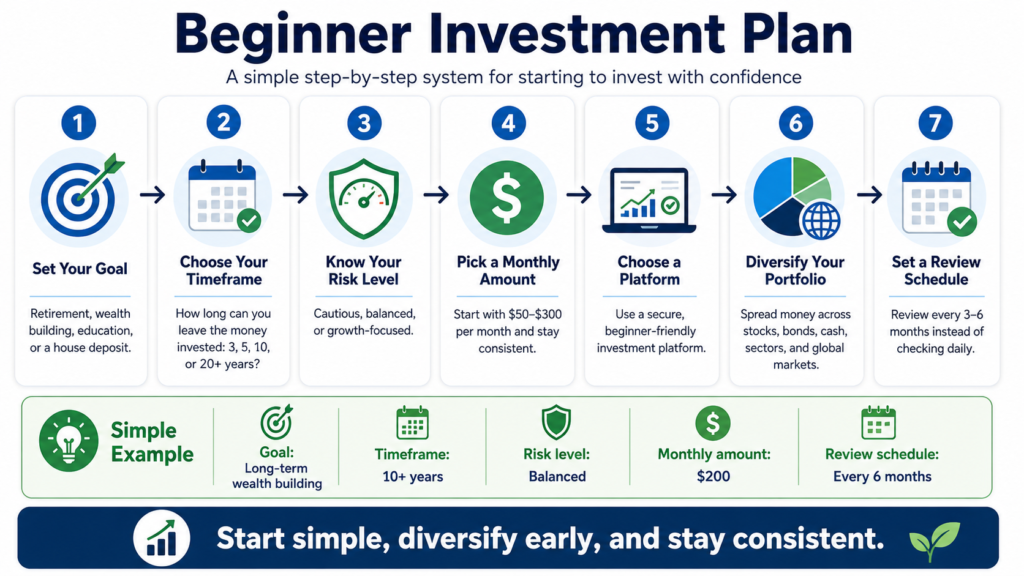
Your plan does not need to be complicated. It can fit on one page.
Include:
- Monthly amount: for example, $100–$300
- Goal: retirement, wealth building, house deposit, education
- Timeframe: 5, 10, 20, or 30 years
- Risk level: cautious, balanced, or growth-focused
- Investment type: funds, ETFs, pension, retirement account
- Review schedule: every 3–6 months
Example plan:
“I will invest $200 per month into a diversified global fund for at least 10 years, while keeping 6 months of expenses in savings. I will review fees and allocation twice per year.”
A plan removes guesswork and reduces panic.
10. Choosing the Wrong Platform for Your Needs
A good investing platform should be secure, easy to use, fairly priced, and suitable for your country.
Do not choose a platform only because it looks modern or someone online recommended it. Check whether it offers the account types, investments, fees, education, and support you need.
Vanguard says that when choosing an investment platform, investors should look for trust, transparency, clear communication, and information that helps them understand investing. (Vanguard Investor)
Recommended Investing Platforms and Tools by Region
Global
- Interactive Brokers — wide market access for experienced investors
- TradingView — useful charts and watchlists
- Yahoo Finance — simple market tracking and research
United States
- Fidelity — strong education and broad account options
- Vanguard — low-cost funds and long-term focus
- Charles Schwab — beginner-friendly platform and research tools
United Kingdom / Europe
- Vanguard Investor — simple fund-focused investing
- Trading 212 — accessible app and fractional shares
- Interactive Investor — broad UK investment account options
Advanced users
- Morningstar — deeper fund and portfolio research
- Portfolio Visualizer — historical portfolio analysis
- Koyfin — advanced market data dashboards
Use tools to compare, learn, and organise your decisions. Do not let tools encourage constant trading.
How to Start Investing More Safely as a Beginner
A safer beginner approach is simple, slow, and repeatable.
Use this checklist:
- Build an emergency fund
- Pay down high-interest debt
- Choose a clear investing goal
- Learn basic terms: stocks, bonds, ETFs, funds
- Pick one trusted platform
- Start with $50–$300 monthly
- Diversify instead of betting on one company
- Review every 3–6 months, not every day
Investor.gov explains that asset allocation means dividing a portfolio among categories such as stocks, bonds, and cash, and that the right mix depends on time horizon and risk tolerance. (Investor)
FAQ
What is the biggest investing mistake beginners make?
The biggest mistake is investing without a plan. Beginners often buy based on hype, emotion, or short-term excitement instead of matching investments to their goals, risk tolerance, and timeframe.
How much should a beginner invest each month?
A realistic beginner range is $50–$300 per month, depending on income, debt, expenses, and savings. It is better to invest consistently than to start too large and stop after a few months.
Should beginners buy individual stocks?
Beginners can buy individual stocks, but it is usually safer to keep them as a smaller part of the portfolio. Broad funds or ETFs can provide more diversification than relying on one or two companies.
Is it bad to invest during a market downturn?
A downturn is not automatically bad if you have a long-term plan and emergency savings. The bigger risk is investing money you need soon or panic-selling when prices fall.
How can beginners reduce investing risk?
Beginners can reduce risk by diversifying, keeping emergency savings, avoiding hype, checking fees, investing regularly, and choosing investments that match their time horizon and risk tolerance.
Conclusion
Beginner investing mistakes are common, but many are avoidable.
Do not rush into hype, invest money you need soon, ignore fees, or put too much into one stock. Instead, build an emergency fund, understand your risk, diversify, choose a suitable platform, and invest consistently.
The smartest beginner investors are not the ones who predict the market perfectly. They are the ones who create a simple plan and stick with it through normal ups and downs.
CTA: Before you invest your next $50–$300, write down your goal, timeframe, risk level, platform, and monthly amount. A one-page plan can prevent expensive mistakes.