
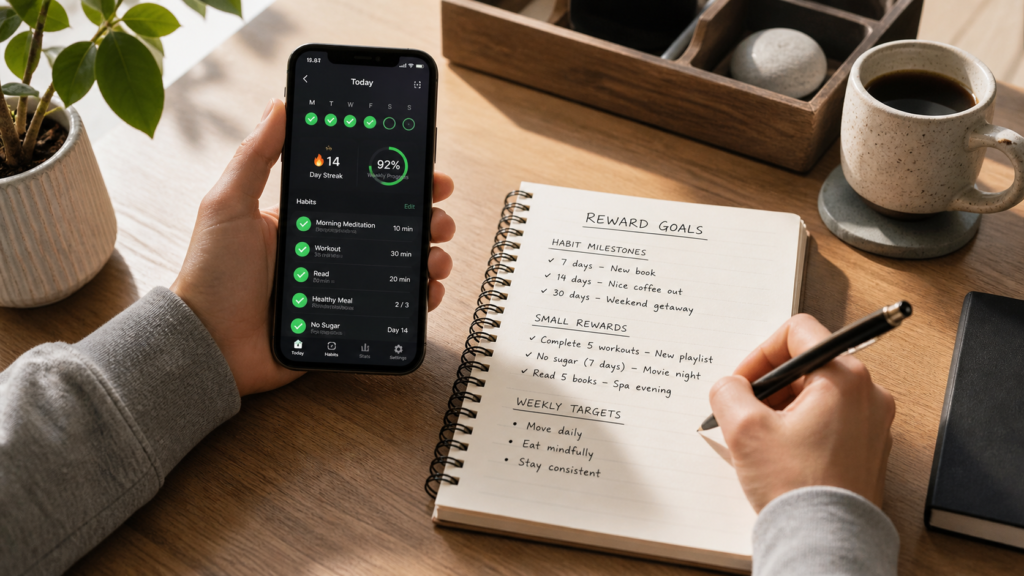
Your brain is designed to repeat what feels rewarding. That is why you check your phone, crave snacks, keep streaks alive, and feel motivated when you see progress.
Reward psychology explains how the brain links actions with positive outcomes. Used wisely, rewards can help you build better habits, stay consistent, and make difficult tasks feel easier. Used poorly, they can pull you into distraction, impulse spending, overeating, or endless scrolling.
The good news is simple: you do not need more willpower. You need a smarter reward system.
What Is Reward Psychology?
Reward psychology is the study of how rewards influence motivation, behaviour, and habit formation. A reward is anything your brain treats as valuable, such as pleasure, progress, praise, relief, novelty, money, food, or social approval.
Rewards teach the brain: “This action is worth repeating.”
For example, when you complete a workout and feel energised afterwards, your brain starts linking exercise with a positive outcome. When you check your phone and see a new message, your brain learns that checking may bring a quick reward.
Dopamine is often linked with reward and motivation. Cleveland Clinic describes dopamine as a brain chemical involved in reward, motivation, memory, mood, attention, and movement. (Cleveland Clinic)
Why Does Your Brain Love Rewards?
Your brain loves rewards because rewards help it learn what to approach, repeat, and prioritise.
In simple terms, your brain is constantly asking:
- Was this useful?
- Did this feel good?
- Should I do it again?
- Was the reward worth the effort?
Midbrain dopamine neurons are strongly involved in reward responses and positive motivation, which helps explain why rewarding experiences can shape behaviour so powerfully. (PMC)
This system is useful. It helps you learn, eat, connect with others, solve problems, and repeat behaviours that support survival. But modern life gives your reward system far more stimulation than it evolved to handle.
A phone notification, online sale, sugary snack, or social media like can deliver a quick reward with almost no effort. That is why smart reward design matters.
How Rewards Shape Habits
A habit is a behaviour that becomes easier and more automatic through repetition. Rewards help habits stick because they give the brain a reason to repeat the action.
A simple habit loop has three parts:
- Cue: the trigger
- Action: the behaviour
- Reward: the positive result
Example:
- Cue: You finish dinner
- Action: You walk for 10 minutes
- Reward: You feel calmer and see progress on your tracker
Over time, the cue becomes linked with the action. The reward strengthens the pattern.
The American Psychological Association notes that habits develop through repeated experiences that produce a reward, rather than through motivation alone. (American Psychological Association)
Good Rewards vs Bad Rewards
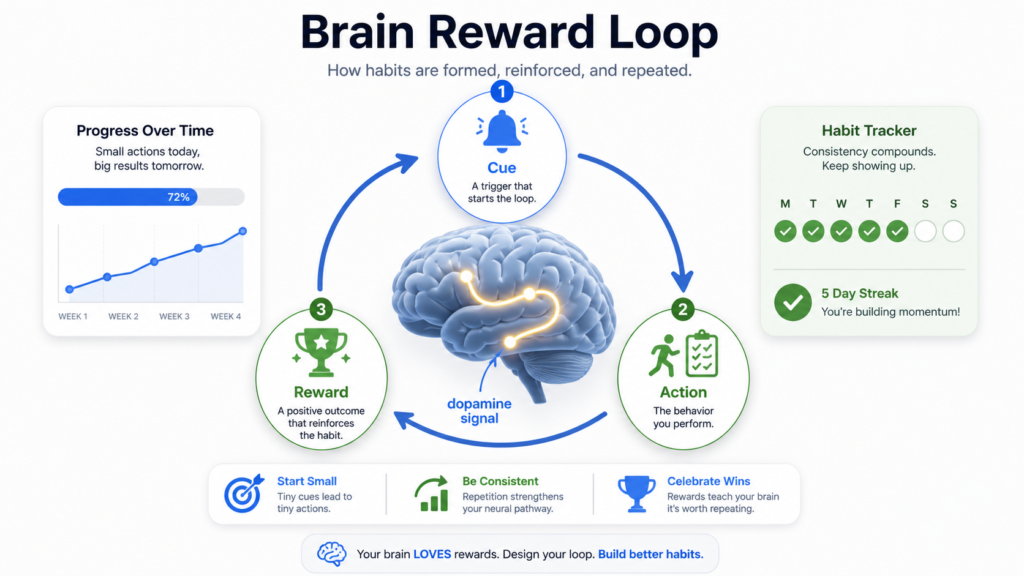
Not all rewards help you.
A good reward supports the person you want to become. A bad reward gives short-term pleasure but makes your long-term goal harder.
Good reward examples
- Taking a relaxing walk after focused work
- Watching one episode after completing your study session
- Adding $10 to a savings goal after a no-spend day
- Using a habit tracker to mark progress
- Enjoying a favourite coffee after a morning workout
Bad reward examples
- Buying something expensive after every stressful day
- Eating junk food after every minor achievement
- Scrolling for 2 hours after 20 minutes of work
- Skipping sleep as a “reward” for being productive
- Using alcohol or gambling as stress relief
A useful rule: your reward should not undo the behaviour you are trying to build.
How to Use Rewards Wisely
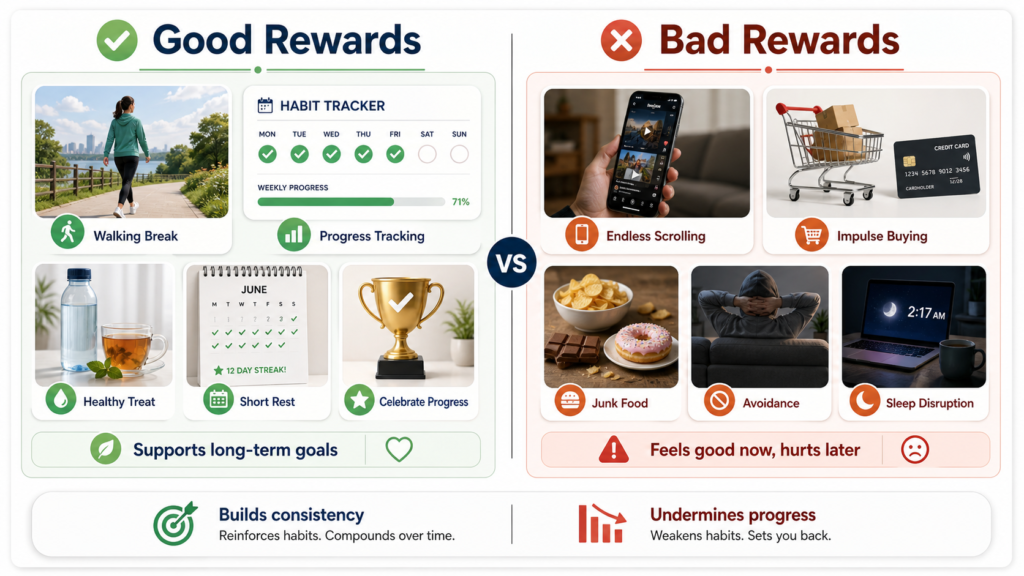
The smartest rewards are immediate, healthy, and connected to the habit.
For example, if your goal is to read more, do not wait 6 months to reward yourself. Give your brain a small positive signal today. Track the pages, tick a box, enjoy a comfortable reading spot, or listen to calm music while reading.
Step 1: Choose one behaviour
Start with one clear habit. Avoid vague goals such as “be healthier” or “be productive.”
Better examples:
- Walk for 15 minutes after lunch
- Read 10 pages before bed
- Save $50 every payday
- Study for 25 minutes before checking social media
- Prepare tomorrow’s lunch after dinner
One behaviour is easier to reward than a whole lifestyle change.
Step 2: Make the reward immediate
Immediate rewards work better because the brain connects them quickly with the action.
Example:
After a 25-minute focus session, reward yourself with:
- A 5-minute break
- A cup of tea or coffee
- A short walk
- A checked box in your tracker
- One song you enjoy
For bigger goals, use layered rewards. Give yourself a small reward daily and a bigger reward after 30 days.
Step 3: Keep rewards proportionate
The reward should match the behaviour.
Saving $20 should not be rewarded with a $90 purchase. Completing a 10-minute walk does not need a 1,200-calorie treat. A healthy reward keeps progress moving forward.
Practical example:
- Habit: Save $100 this month
- Reward: Spend $10–$20 on a low-cost treat
- Result: You still keep 80–90% of the progress
This approach works because you enjoy the win without cancelling it.
Step 4: Track visible progress
Progress itself is rewarding.
That is why streaks, charts, checkmarks, calendars, and progress bars are motivating. They turn invisible effort into visible proof.
Apps such as Streaks focus on building daily streaks, while Habitica uses game mechanics such as gold, experience, and items to reward real-life tasks. (Streaks)
A simple scenario: if you complete 20 workouts in 30 days, seeing 20 marked days on a calendar gives your brain a clear visual reward.
Real Tools and Apps That Use Rewards
Reward-based tools can help when they make progress visible and encourage consistency. They should support your behaviour, not distract you from it.
Global
- Habitica — turns tasks into game-style rewards
- Todoist — uses productivity streaks and completion feedback
- Notion — custom habit dashboards and visual tracking
United States
- Fabulous — guided routines with habit coaching
- Finch — self-care rewards through a virtual companion
- Way of Life — simple habit trend tracking
United Kingdom / Europe
- Streaks — simple habit streak tracking on Apple devices
- Loop Habit Tracker — free Android habit tracking
- Google Calendar — simple reminders and routine scheduling
Advanced users
- Beeminder — financial stakes for goal accountability
- RescueTime — behaviour data for productivity rewards
- Toggl Track — time tracking for measurable progress
A good tool should reduce friction. If the app takes longer to manage than the habit itself, simplify your system.
How to Avoid Reward Traps
Reward traps happen when your brain starts chasing quick pleasure instead of meaningful progress.
Common examples include:
- Checking social media for “just 5 minutes”
- Buying unnecessary items because they are discounted
- Snacking out of boredom rather than hunger
- Playing mobile games to avoid difficult tasks
- Repeatedly refreshing messages or notifications
These rewards are powerful because they are quick, easy, and unpredictable.
Use friction to protect your attention
Friction means making unwanted behaviours slightly harder.
Examples:
- Turn off non-essential notifications
- Remove shopping apps from your home screen
- Keep snacks out of your desk drawer
- Use website blockers during work
- Put your phone in another room for 25 minutes
A 10-second barrier can be enough to break an automatic reward loop.
How to Build a Smarter Reward System
A smarter reward system makes good habits easier and bad habits less tempting.
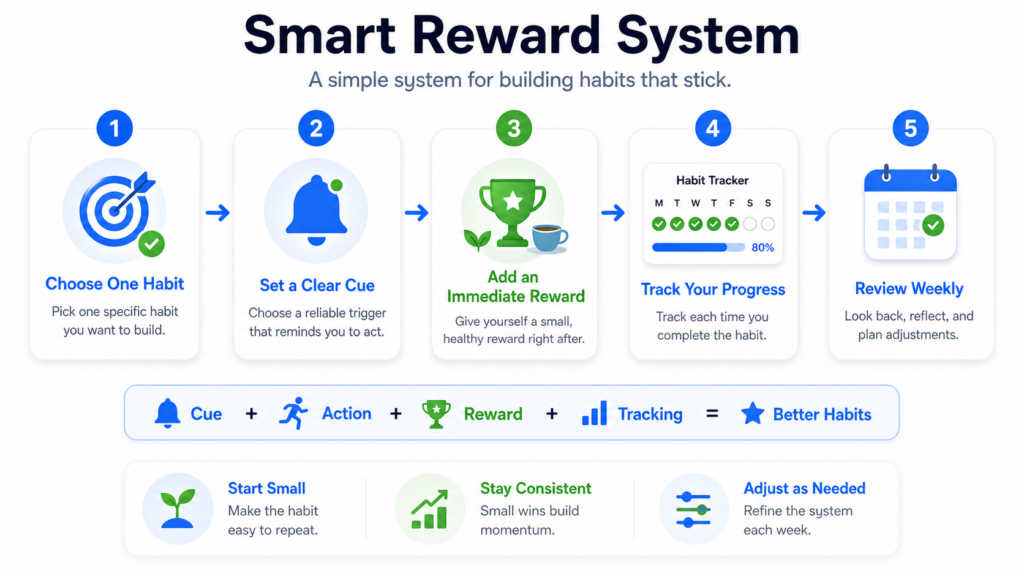
Use this simple structure:
- Pick one habit
- Attach it to a clear cue
- Reward it immediately
- Track it visually
- Review it weekly
- Adjust the reward if motivation drops
Example:
Goal: Study consistently
Cue: After dinner
Action: Study for 25 minutes
Reward: Watch one short video or take a relaxing walk
Tracker: Mark one calendar square
Weekly review: Check completed sessions every Sunday
After 4 weeks, you may complete 12–20 study sessions without relying on motivation every day.
Reward Ideas That Do Not Cost Much
Rewards do not need to be expensive. In fact, low-cost rewards are often better because they are easier to repeat.
Try these:
- 10 minutes outside
- A favourite drink at home
- A relaxing shower
- A podcast episode
- A checked habit tracker box
- A guilt-free rest break
- A call with a friend
- A new playlist
- A $5–$15 monthly treat
- A progress photo or journal entry
For money goals, keep rewards within 5–10% of the amount saved. If you save $200, a $10–$20 reward keeps the habit enjoyable without damaging the result.
FAQ
Why does my brain crave rewards so much?
Your brain craves rewards because rewards help it learn what to repeat. Positive outcomes such as pleasure, progress, praise, or relief teach your brain that an action is worth doing again.
How can I use rewards to build better habits?
Choose one behaviour, make it easy, and reward it immediately. For example, after a 20-minute workout, mark your tracker, enjoy a relaxing drink, or take a short break. The reward helps your brain connect the habit with a positive outcome.
Are rewards bad for motivation?
Rewards are not bad when used wisely. They become a problem when they replace the real purpose of the habit or encourage unhealthy behaviour. The best rewards support your long-term goal rather than undoing it.
What are good rewards for productivity?
Good productivity rewards include short breaks, walks, music, habit streaks, progress charts, or a small treat after completing focused work. Keep the reward quick, healthy, and proportionate to the task.
How do I stop chasing quick rewards?
Reduce easy access to distractions. Turn off notifications, remove tempting apps from your home screen, use website blockers, and replace quick rewards with better ones such as movement, progress tracking, or planned breaks.
Conclusion
Your brain loves rewards because rewards help it learn, repeat behaviour, and stay motivated. The problem is not rewards themselves. The problem is using the wrong rewards in the wrong places.
To use reward psychology wisely, start small. Pick one habit, connect it to a clear cue, reward it immediately, and track your progress. Then review the system weekly and adjust it as needed.
A smart reward system can help you study, exercise, save money, reduce screen time, and build routines that feel easier to repeat.
CTA: Choose one habit today and design a simple reward for it. Keep it healthy, immediate, and small enough to repeat for the next 30 days.