
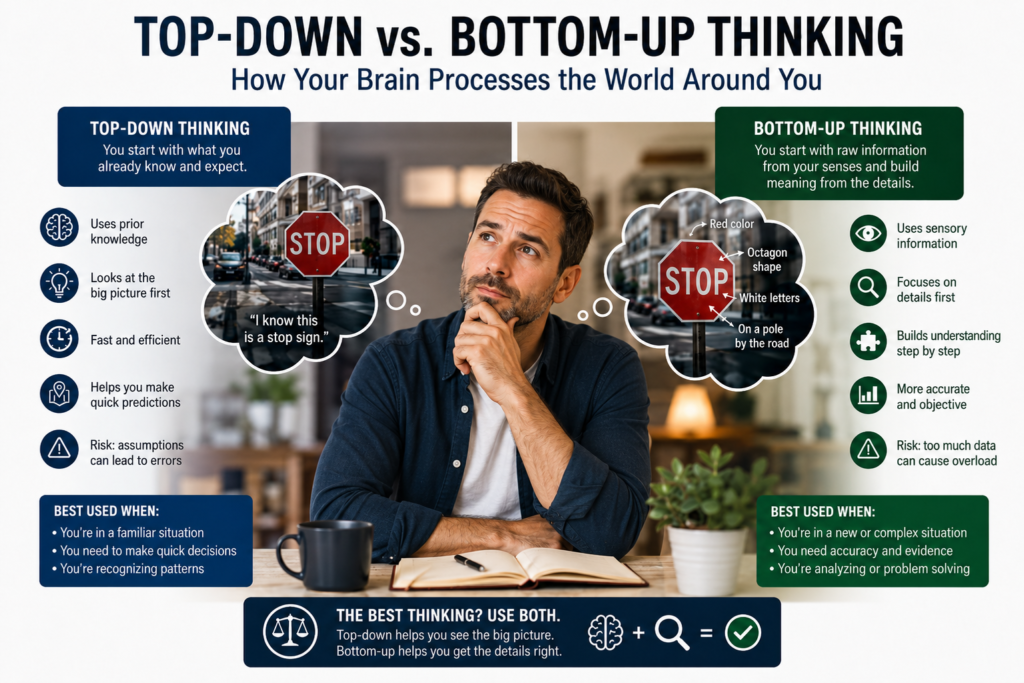
Every second, your brain is trying to make sense of the world around you. You hear sounds, recognise faces, read words, notice movement, judge situations, and make quick decisions — often before you consciously realise what is happening.
That is where top-down vs bottom-up thinking comes in.
Bottom-up thinking starts with raw information from your senses and builds meaning from the details. Top-down thinking starts with your existing knowledge, expectations, memories, and beliefs, then uses them to interpret what you see, hear, or experience.
In simple terms:
- Bottom-up thinking: “What information is coming in?”
- Top-down thinking: “What do I already know about this?”
- Best thinking: using both together
Understanding the difference can help you avoid lazy assumptions, read situations more accurately, learn faster, and make better decisions in everyday life.
What Is Bottom-Up Thinking?
Bottom-up thinking is a way of processing information that begins with details, evidence, or sensory input. Your brain collects small pieces of information first, then builds a bigger understanding from them.
It is called “bottom-up” because you start at the bottom — the raw data — and work upwards towards meaning.
Imagine you hear a loud noise outside your window. With bottom-up thinking, your brain notices the details first:
- The sound was sudden
- It came from the street
- It sounded like metal hitting the ground
- It lasted less than a second
From those clues, you may conclude that someone dropped a bike, a bin lid fell, or a car door slammed.
You are not starting with a fixed belief. You are building the explanation from what you actually noticed.
A doctor uses bottom-up thinking when they collect symptoms, check test results, ask questions, and build a diagnosis from the evidence. This style is especially useful when accuracy matters and assumptions could lead to mistakes.
What Is Top-Down Thinking?
Top-down thinking is a way of processing information using your existing knowledge, expectations, memories, and beliefs. Instead of building meaning only from raw details, your brain uses what it already knows to interpret the situation quickly.
It is called “top-down” because you start with the bigger picture first, then use it to understand the details.
For example, imagine you see a blurry shape in your kitchen at night. Before checking carefully, your brain may instantly think:
“That is probably a chair.”
Why? Because you already know the layout of your kitchen. Your memory helps you interpret the shape quickly.
That is top-down thinking.
It also happens when you read a sentence with a missing letter:
“The br_in processes information.”
You probably read it as brain because the context guides you. Your brain does not need perfect information every time. It uses expectation to fill in the gaps.
That can be helpful — but it can also lead to mistakes.
Top-Down vs Bottom-Up Thinking: The Main Difference
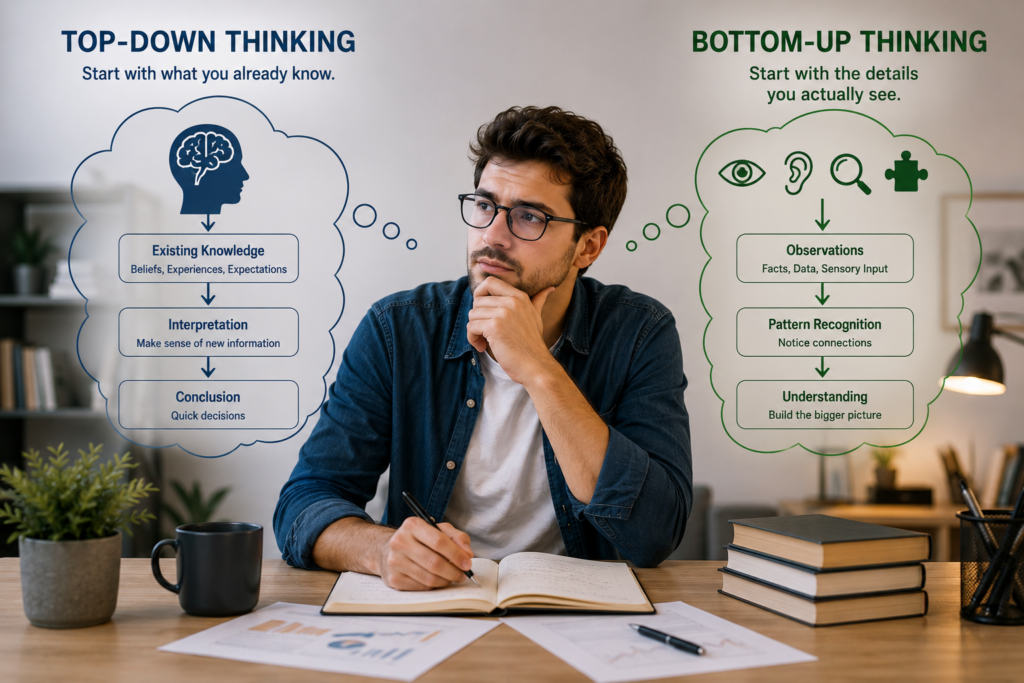
The main difference between top-down and bottom-up thinking is where your brain starts.
Bottom-up thinking starts with the evidence. Top-down thinking starts with expectations.
| Thinking Style | Starts With | Best For | Main Risk |
|---|---|---|---|
| Bottom-up thinking | Details and evidence | Accuracy and discovery | Can be slow |
| Top-down thinking | Prior knowledge and expectations | Speed and pattern recognition | Can create bias |
Imagine you receive a short message from a friend:
Fine.
Bottom-up thinking notices the actual evidence: the reply is short, neutral, and lacks emotional detail.
Top-down thinking adds context: your friend often says “fine” when annoyed, and you had a disagreement yesterday.
A balanced interpretation would be:
“They might be annoyed, but I do not know for sure. I should check calmly rather than assume the worst.”
This is why the best thinking usually combines both systems.
How Your Brain Uses Both at the Same Time

Your brain rarely uses only one style. Most real-world thinking combines bottom-up and top-down processing.
Bottom-up processing brings in information from your senses. Top-down processing helps organise that information using memory, language, experience, and expectation.
Imagine walking into a café.
Your bottom-up system notices:
- The smell of coffee
- The sound of conversation
- People standing in a queue
- A menu board on the wall
- Tables, chairs, cups, and plates
Your top-down system interprets the scene:
- “This is a café.”
- “I probably order at the counter.”
- “The menu is likely above the till.”
- “The people in line are waiting to order.”
You do not need to analyse every object from zero. Your previous experience helps you understand the scene quickly.
But there is a catch. If the café works differently — for example, table service only — your expectation could mislead you. That is when you need to slow down and look at the actual evidence.
Why Top-Down Thinking Is Useful
Top-down thinking is useful because it saves time and mental energy.
Without it, everyday life would feel painfully slow. You would have to interpret every face, word, sound, object, and situation from the beginning every single time.
Top-down thinking helps you:
- Recognise familiar places quickly
- Understand unclear speech
- Read messy handwriting
- Predict what may happen next
- Make fast decisions in familiar situations
A good example is driving.
An experienced driver can often spot danger faster than a beginner. They notice small signs:
- A child standing near the kerb
- A car edging forward
- Brake lights ahead
- A cyclist looking over their shoulder
- A pedestrian glancing at traffic
The driver’s brain uses past experience to predict risk before anything dramatic happens.
That is top-down thinking working well. It helps the brain recognise patterns quickly and act before a problem becomes serious.
Why Bottom-Up Thinking Is Useful
Bottom-up thinking is useful when you need to slow down, observe carefully, and avoid jumping to conclusions.
It is especially important when the situation is unfamiliar, complex, emotional, or expensive.
Bottom-up thinking helps you:
- Solve new problems
- Investigate what actually happened
- Learn a new skill
- Analyse data
- Notice details you might normally ignore
- Challenge your first impression
Imagine your laptop keeps slowing down.
Top-down thinking might say:
“My laptop is old. I need a new one.”
Bottom-up thinking checks the evidence first:
- Is the storage almost full?
- Are too many apps running?
- Is the browser using too much memory?
- Is the laptop overheating?
- Is the internet connection the real issue?
- Could a software update fix the problem?
You might discover that the issue is fixable without buying a replacement.
This is why bottom-up thinking can protect you from expensive assumptions. It forces you to check what is actually happening before deciding what it means.
When Top-Down Thinking Goes Wrong
Top-down thinking becomes a problem when your expectations overpower the evidence.
This is how misunderstandings, stereotypes, confirmation bias, and false assumptions can happen.
Imagine someone is quiet during a meeting.
Your top-down reaction might be:
“They are rude.”
But the bottom-up evidence may suggest other possibilities:
- They are tired
- They are shy
- They are new to the team
- They are concentrating
- They are worried about speaking up
- They do not fully understand the topic yet
Your first interpretation may feel obvious, but it may not be accurate.
Top-down thinking often uses mental shortcuts. These shortcuts are useful, but they can make you see what you expect to see instead of what is really there.
That is why two people can witness the same event and interpret it differently. Their brains are not just recording reality. They are filtering it through experience, memory, emotion, and expectation.
When Bottom-Up Thinking Goes Wrong
Bottom-up thinking can also cause problems if you focus too much on details and miss the bigger picture.
Too much raw information can become overwhelming. You may collect more and more evidence without making a decision.
This is sometimes called analysis paralysis.
Imagine you are choosing a new phone. You compare:
- Camera specifications
- Battery capacity
- Processor speed
- Screen brightness
- Storage options
- User reviews
- Price differences
- Software update promises
Bottom-up analysis is useful, but at some point, you need top-down judgement:
“What do I actually need this phone for?”
If you mostly browse, message, take family photos, and watch videos, you may not need the most expensive model. The bigger picture helps you decide.
Bottom-up thinking gives you details. Top-down thinking helps you judge which details actually matter.
How to Use Top-Down and Bottom-Up Thinking Better
The best thinkers do not rely on only one style. They switch between both.
Use top-down thinking to recognise patterns quickly. Use bottom-up thinking to test whether your assumptions are correct.
A simple method is to ask four questions:
- What do I think is happening?
This reveals your top-down assumption. - What evidence do I actually have?
This activates bottom-up thinking. - What else could explain this?
This reduces bias. - What is the safest next step?
This turns thinking into action.
Imagine you send a message and receive a short reply.
Your top-down reaction might be:
“They are annoyed with me.”
Your bottom-up check might be:
“They only wrote three words, but I do not know why.”
A balanced next step would be:
“Maybe they are busy. I will wait, or I will ask calmly if everything is okay.”
This simple pause can prevent unnecessary arguments, poor decisions, and emotional overreactions.
Helpful Tools for Thinking, Learning, and Note-Taking
You do not need expensive tools to improve your thinking. A notebook is often enough. But reliable learning and note-taking platforms can help you organise ideas, compare evidence, and spot patterns more clearly.
- Global: Notion (organise notes, ideas, and projects clearly)
- Global: Obsidian (connect ideas through linked personal notes)
- United States: Coursera (structured courses from recognised universities)
- United States: Khan Academy (free learning across core subjects)
- UK & Europe: FutureLearn (UK-based courses from universities and institutions)
- UK & Europe: OpenLearn (free learning from The Open University)
These tools are useful for students, writers, creators, professionals, and anyone who wants to understand complex topics more clearly.
FAQ
What is the difference between top-down and bottom-up thinking?
Top-down thinking starts with existing knowledge, expectations, or assumptions. Bottom-up thinking starts with raw details, evidence, or sensory information. Most everyday thinking uses both at the same time.
Is top-down thinking bad?
No. Top-down thinking is useful because it helps you make fast sense of familiar situations. It only becomes a problem when your assumptions ignore evidence or create unfair judgements.
Is bottom-up thinking better than top-down thinking?
Not always. Bottom-up thinking is better for careful analysis and unfamiliar problems. Top-down thinking is better for speed, pattern recognition, and using experience. The best approach depends on the situation.
How do top-down and bottom-up thinking affect learning?
Bottom-up thinking helps you notice details and build knowledge step by step. Top-down thinking helps you connect new information to what you already know. Good learning usually needs both.
How can I stop jumping to conclusions?
Pause and ask: “What evidence do I actually have?” Then consider at least two alternative explanations. This slows down automatic top-down assumptions and brings in more bottom-up evidence.
Conclusion
Top-down vs bottom-up thinking explains how your brain turns raw information into meaning.
Bottom-up thinking starts with the details. It helps you observe carefully, check evidence, and avoid lazy assumptions.
Top-down thinking starts with what you already know. It helps you recognise patterns, understand context, and make quick decisions.
Neither style is perfect on its own.
The real skill is knowing when to trust your expectations and when to slow down and check the evidence. Once you understand that balance, you can read situations more clearly, learn more effectively, and make smarter decisions in everyday life.