
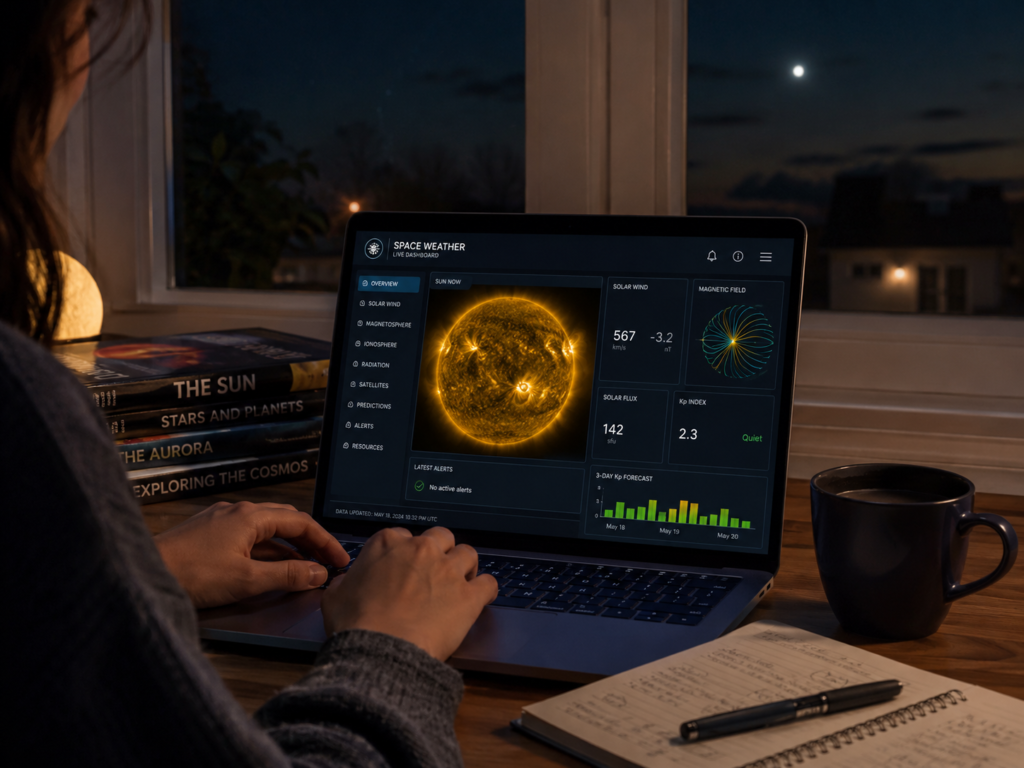
Probably you have heard on the news about a “solar flare” or a “stellar flare.” It sounds a bit worrying—the last thing any of us wants to hear is that the Sun is becoming unstable! In this article, we are going to dive into what is actually happening up there and whether we need to worry.
First, What Even Is a Solar Flare?
According to NASA, solar flares “are intense bursts of radiation and the most powerful explosions in the solar system.”
That might sound terrifying, but let’s remember that the Sun is already a giant mass of continuous explosions. To give you some context, every single second, the Sun releases 3.8 × 10²⁶ Watts of power. That is the equivalent of detonating 100 billion Hiroshima-sized atomic bombs—or 1 billion massive hydrogen Tsar Bombas—every single second!
All of the Sun’s normal heat comes from this massive, bomb-like nuclear fusion in its core. So, if the Sun is already super ultra-hot, why the fuss about a solar flare?
Why Are We Bothered About Solar Flares?
It is a great question. The fuss is not actually about the everyday heat coming from the Sun, which arrives in a nice, predictable, slow-burn pattern. The fuss is about a sudden, violent spike in energy, and the havoc it can wreak on our modern technology.
Imagine you are sitting comfortably in a perfectly warm room during a freezing cold winter, and suddenly someone throws a bucket of gasoline onto the furnace. While a solar flare won’t heat up Earth’s surface weather (thanks to our protective atmosphere), it acts like a cosmic electromagnetic pulse (EMP) for our tech.
How Solar Flares Impact Our Technology?
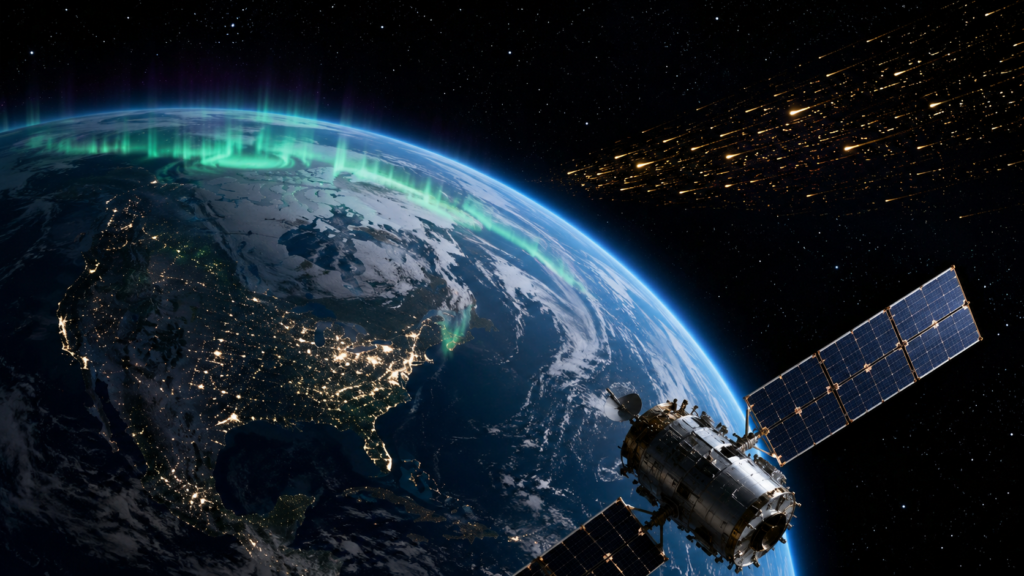
Earth’s upper atmosphere and satellites can be affected by space weather, while auroras glow near the poles as charged solar particles interact with the planet’s magnetic field.
Our modern society relies on invisible systems operating high up in space and in our atmosphere. When a flare hits, three main things happen:
- Radio Blackouts: The sudden burst of radiation instantly energises (ionises) the upper atmosphere. This blocks the high-frequency radio signals used by aviation, maritime shipping, and emergency responders.
- GPS Interference: It bends and scrambles the signals sent by satellites, causing navigation errors for airplanes, ships, and self-driving systems.
- Satellite Damage: The extra energy heats Earth’s upper atmosphere, causing it to puff up like a marshmallow. Satellites orbiting in low Earth orbit hit this unexpected air resistance, slow down, and can actually get pulled completely out of orbit.
Is There a Natural Impact on Earth? (The Beautiful Side)
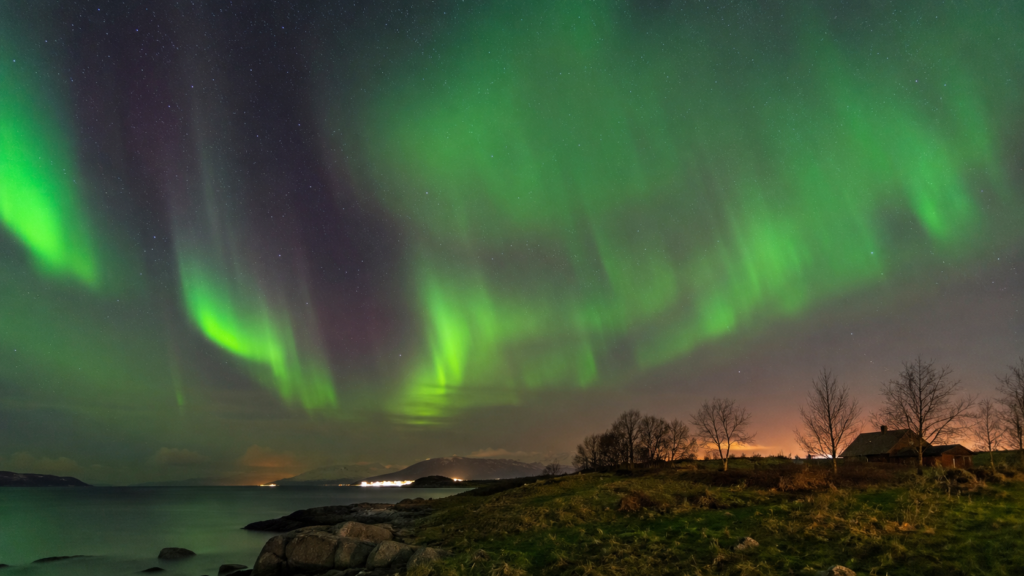
Solar flares themselves are not the main direct cause of auroras. Auroras are usually linked more strongly to charged particles from solar activity interacting with Earth’s magnetic field and atmosphere.
As horrible as solar flares sound, they are often accompanied by a companion event called a Coronal Mass Ejection (CME)—a massive blast of solar plasma. When this physical cloud hits Earth a few days later, it creates one of the most beautiful phenomena on the planet: Auroras. Yes, those lovely dancing green, purple, and pink lights that you can see near both the North and South poles!
What Causes a Solar Flare?
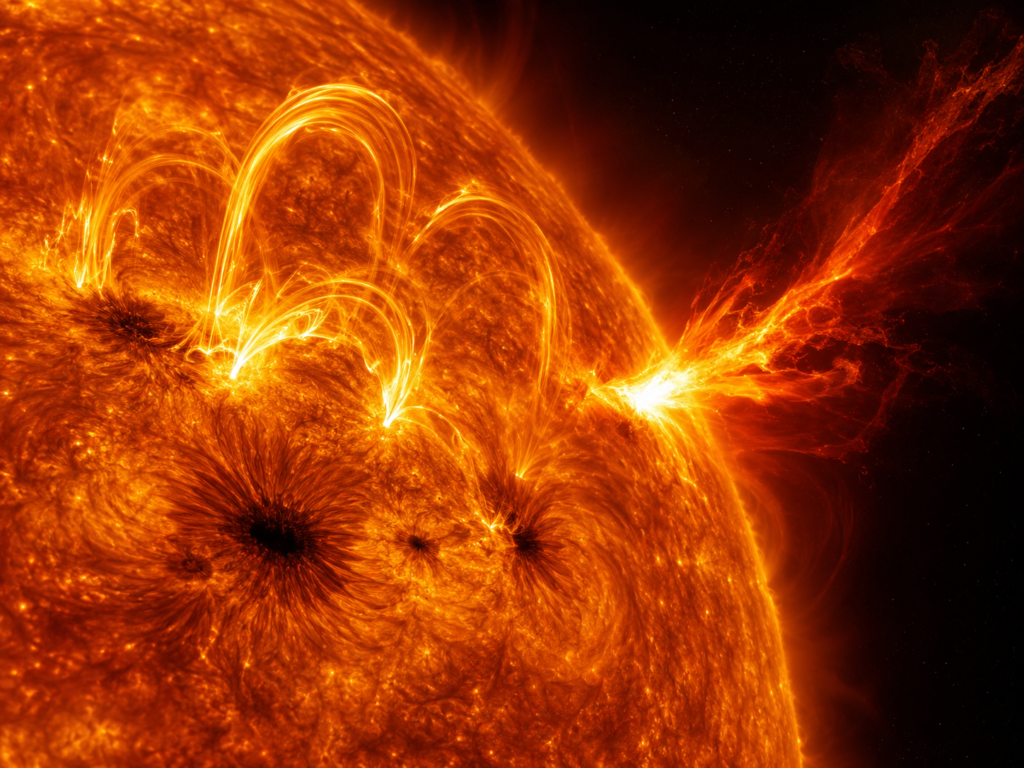
Solar flares follow the Sun’s natural 11-year solar cycle. This cycle is the Sun’s periodic rhythm, where its magnetic activity fluctuates between quiet and chaotic. But what triggers the actual explosion?
It all happens in active regions on the Sun (often marked by dark sunspots):
- Magnetic Reconnection: As the Sun’s plasma churns, its magnetic field lines become twisted, tangled, and stressed like rubber bands. When these field lines finally snap and rapidly realign—a process known as magnetic reconnection—they release immense amounts of stored energy in just a few minutes.
- Energy Release: A single major solar flare can release energy equivalent to millions of hydrogen bombs exploding simultaneously. This superheats the solar plasma to tens of millions of degrees and accelerates charged particles to nearly the speed of light.
This matters because the ionosphere helps reflect and carry some radio communications.
Are All Solar Flares the Same?
Short answer: No! A solar flare can last anywhere from a few minutes to a few hours. Scientists classify their strength into different letter categories, similar to the Richter scale for earthquakes:
| Class | Power / Impact |
| A & B | Background level; negligible impact on Earth. |
| C | Minor flares with no noticeable impact on Earth. |
| M | Medium intensity; can cause brief radio blackouts near the polar regions. |
| X | Most powerful explosions. Can trigger planet-wide radio blackouts and severe disruptions to technological infrastructure. |
Can We Watch a Solar Flare with the Naked Eye?
Absolutely not, and you should never try. The Sun’s surface is already blindingly bright, and most of the energy released by a flare is in wavelengths invisible to human eyes, like X-rays and UV light.
Looking directly at the Sun is incredibly unsafe—and no, regular sunglasses will not protect your eyes! Sunglasses actually cause your pupils to dilate, letting even more harmful radiation in. To view the Sun safely, you must use ISO-compliant eclipse glasses or specialized solar telescopes.
Real Examples from History
Space weather isn’t just a theory; it has brought our technology to a grinding halt before:
- The Carrington Event (1859) – The Modern Blueprint: A massive flare erupted, and the global telegraph system (the “Victorian Internet”) went completely haywire. Telegraph wires sparked, causing fires in offices. Shockingly, even after operators disconnected the batteries, the lines continued sending messages purely using the electricity induced in the wires by the solar storm.
- The Great Quebec Blackout (1989) – The Night the Lights Went Out: A solar storm induced massive electrical currents right into the ground in Canada. It found its way into the Hydro-Québec power grid, overloading transformers and knocking out the entire grid in less than 90 seconds. Six million people were left in the freezing dark for over 9 hours.
- The Halloween Storms (2003) – The Satellite Killer: A Japanese satellite was permanently destroyed, and more than half of all Earth-orbiting science satellites experienced malfunctions. Airplanes flying over the North Pole lost radio contact and had to be rerouted, while power grids in Sweden suffered blackouts.
- The SpaceX Starlink Incident (2022) – The Atmosphere Puff: A relatively minor solar storm heated Earth’s upper atmosphere, causing it to expand. SpaceX had just launched a batch of 49 Starlink satellites. Because the atmosphere puffed up, the satellites hit unexpected air resistance, stalled out, and 38 of them fell back into the atmosphere and burned up days after launch.
How You Can Track Solar Flares and CMEs Yourself
You don’t have to wait for the evening news to find out if the Sun is acting up. Because space weather data is open and public, there are incredible free tools and apps you can use right on your phone to track solar flares and see if an aurora is headed your way.
Here are the absolute best tools used by space enthusiasts and aurora hunters:
- SpaceWeatherLive (App & Website): This is the ultimate, beginner-friendly all-in-one app. It sends free push notifications to your phone the second a major solar flare erupts or a geomagnetic storm begins. It also features live, easy-to-read graphs and an active news feed written by space experts.
- Lumara (App): A fantastic, clean app for both iOS and Android that pulls data straight from NASA’s space weather databases. It breaks down the current solar flare class and geomagnetic activity with zero ads or tracking.
- My Aurora Forecast (App): If your main goal is to see the beautiful side of solar flares (the auroras), this app is essential. It tracks the “Kp index” (the scale used to measure geomagnetic storms) and sends alerts when the lights might be visible from your location.
- NOAA Space Weather Prediction Center (Website): The official government site that the experts use. If you want to see live, 30-minute moving forecast maps of the Northern and Southern lights dancing over the poles, this is the place to look.
The Verdict: Should We Worry?
For our physical bodies on the ground? Not at all. Earth’s magnetic field and atmosphere act as a perfect shield. But for our tech-driven world? Solar flares are a cosmic wildcard. While they won’t destroy the planet, they remind us just how dependent we are on the grid—and give us a spectacular light show in the process!
FAQ
Can a solar flare hurt humans on Earth?
No. Earth’s atmosphere and magnetic field act as a perfect shield, completely blocking harmful cosmic radiation from reaching the surface and keeping our physical bodies entirely safe.
Can you see a solar flare with regular sunglasses?
Absolutely not. Regular sunglasses do not filter out intense solar wavelengths. Looking directly at the Sun can cause permanent eye damage; you must use certified ISO-compliant eclipse glasses or specialized solar telescopes.
Do solar flares cause the Northern and Southern Lights?
Yes, indirectly. Solar flares are frequently accompanied by Coronal Mass Ejections (CMEs), which are massive clouds of solar plasma. When these physical clouds collide with Earth’s magnetic field a few days later, they trigger beautiful dancing auroras at both poles.
Is there an app to track solar flares?
Yes! Free mobile apps like SpaceWeatherLive and Lumara pull real-time data directly from NASA and NOAA satellite systems to send live alerts about active solar flares, solar cycles, and upcoming aurora storms straight to your phone.